Monday, May 9, 2016

Amalfi Images II

The two most important industries on the Amalfi coast are tourism and lemons.  We were doing our part with the first and the locals have been busy for a millennium with the second.  Every possible square meter of the steep hillsides are terraced for lemon trees.  The heavy yellow fruit hands gleaming under the bright sun.  Whole orchards are netted with black fabric to protect the fruit.  This is big business.  Besides the huge amount of export, the lemons make a big contribution to the local cuisine, which sports lemon sauced fish, lemon chocolate, lemon you name it.  The majority of these lemon orchards are accessible only by means of ancient stairways that are steep enough to induce nosebleeds.  I know whereof I speak because we have spent the last two days tramping over literally thousands and thousands of stairs as we hiked the paradise of the hills above the coast.  More on that in a detailed future entry.

Looking south down the coast one can see the town of Salerno in the distance.  Below is on of the first villages along the coast.  

Whew!  Finally, I have been able to at least get the blog moved along to the location that we are currently in.  More about hiking the coast when the blood returns to my fingers.  Now I need to relax on the balcony and watch the motto parade.  Well fed and relaxed after a long steep day of hiking, I have to rest up a bit for our excursion to Pompeii on the morrow.  Ciao for Now!

Amalfi Coast Bus Ride

The Amalfi coast is an amazingly rugged place where the mountains drop into an azure sea.  Even more amazing is the insanity of driving up the road that hugs the cliffs and rocks.  Before the road was built in the 1860's, the small towns of the coast were only accessible via boat or the trails consisting of thousands of stairs carved out of rock or laid with ancient volcanic flagstones.  The trails are still very much a part of life here, but more of those later.

Our bus careened around the many, many hairpin turns, rolling the passengers from side to side.  Many of the turns are so narrow that cars are forced to back up to allow the bus to clear the turn.  Mix this logistical challenge with Saturday traffic, day trippers, buses, delivery trucks, and a horde of motociclisti weaving through the heavy traffic and you get an idea of the chaos amidst the beauty.  And all of this for 2.20 Euro per person. 

One of the tiny villages hugging the coast while the mountains rise out of the sea.

Onwards to the Amalfi Coast

It was backpacks on and a warm walk through the teeming streets of Napoli.  We navigated without fail to the Central Station, the modern train hub of Napoli.  From here, the fast trains head north to Rome and onwards, carrying tourists to the Big Three, Roma, Venice and Florence.  Not nearly as many folks make it to southern Italy and those that do often make it no further than Naples, Sorrento or the island of Capri.  Today we were heading further south, first via train to Salerno and then, via public bus, back north along the Amalfi coast to the little town of Minori.
We drew the fancy train, air-conditioned, fold down trays, the works.  It was a thirty minute ride to Salerno, heading just north of Vesuvius, the volcano that made Pottery Barn figurines out of the Roman inhabitants of Pompeii.  The ride was super plush and comfortable, the train was on time, and the toll was 14 Euro each one way.  

Salerno is a laid back town on the south side of the mountainous peninsula that makes up the southern sweep of  the Neapolitan bay.  We had some quality cafe' time while waiting for our local bus.  Adding to the spice of people watching was a large wedding party complete with wonderfully ornate costumes.  It was a sort of Victorian Goth meets steam-affair, with top hats, cutaway coats and antique railroading goggles.  Quite a treat to watch while sipping an espresso at the comfortable street side tables.  Then it was time to board our local for the jaunt up the Amalfi coast.

The view from the inside of the bus.  I will post images of the coast in the next entry.  The only casualty of the ride was the guy sitting behind us.  The poor tourist got slammed in the head when someone else's bag fell from the overhead rack.  I think it really rang his bell.  

An hour of hair-pin turns negotiated by a full size bus and we were deposited in the tiny town of Minori on the rocky shores of the Mediterranean.  All travel days should be this easy. 

Them Dry Bones

Catacomb burial has been a part of life in Napoli since before the current era.  That's BC in non-politically correct historian speak.  The catacombs at San Gennaro were being used as a burial ground long before there was a San Gennaro.  Pagans tunneled into the solid volcanic rock above Napoli and in those tunnels they stored their dead.  The Christians just co-opted the ground once they were the religion of power.  The catacombs are still there, but all of the bones were removed under orders issued in the 19th century.  

We walked up the long hill out of the historic Centro, threading our way through clogged market streets and the usual bustle of Napoli street life.  After a long climb up to the Parco atop the hill, we dropped back down to the basilica of San Gennaro and smack into the start of a tour in English.  I love a good cemetery, just love the damn things.  Yeah, it may be a bit ghoulish, but I have found memories of graveyards across the globe.  Down we went, descending stairs along the outside of the outcropping of rock that San Gennaro is built on.   Further into the Rock, tunneled behind the catacombs is a modern wonder, the Italian Auto Strada, which alternates between tunnels and bridges to circumnavigate the hills of Napoli.

Delicious shivers of cold ran down my spine as we entered the catacombs.  A twenty degree (F) drop in temperature will do that.  Graves are carved out of the floor, the oldest burials, while the walls are pocked with carved niches, on atop another.   The graves were covered with terra cotta or marble slabs, most of which have long since disappeared.  The remains of mosaics and frescoes line the inside of the niches, depicting the families that were buried there.  It was fascinating to imagine all of these niches crammed with the long dead bones of the Neapolitans.  I admit to being disappointed when I learned that all of the bones had been removed, but I now know that I can go visit them anytime I want in the cemetery where they were all interred.  That must have been a hell of a moving party.  

The first level of the catacombs.  You can see the graves carved in the floor and the niches climbing up the walls.  

The relics of San Gennaro are stored here in this pit that served as his grave for centuries.  His sacred bones were moved to the Basilica over a hundred years ago.

The third level, spooky lighting and all.

Saturday, May 7, 2016

Napoli Walkabout

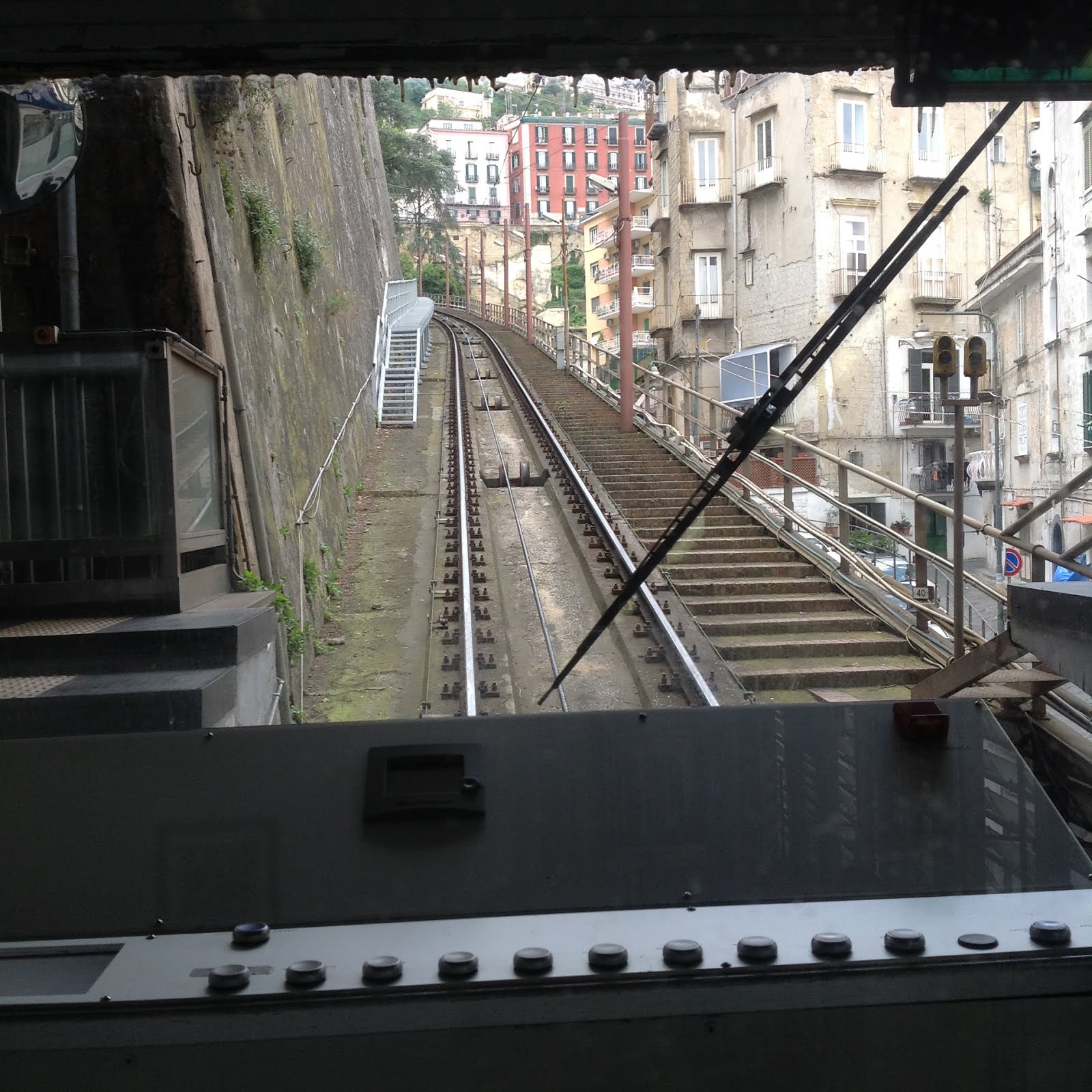
For me, Napoli is one of the great walking cities in the world.  Like Bangkok and Lisboa, Napoli is a city the defies even a well-honed sense of direction.  And like those other great cities, Napoli is so much fun to get lost in, it is worth the getting lost.  Napoli is also a steep city, full of near vertical hills, sheer drops, elevated roadways over sunken neighborhoods and dead-ends.  When the going gets too steep, the smart walker drops a Euro ticket fare and climbs aboard one of the funiculares that rattle their way up the steepest hillsides.

The funiculare that climbs from the Historico Centro up to one of the hilltop Castellos.

All of that walking will put the hunger on a Brother.  Fear not.  In Napoli, only fools go hungry.  One is never more than a stones throw from a cafe', an espresso bar, a gelateria or the fried pizza carts.  Street food, southern Italian style.  For five Euro, a weary walker can get a big paper cone full of fried treats including fired risotto balls, and polenta cubes.  If that won't keep you on your feet, you should just throw yourself in front of a scooter and be done with it.

Speaking of scooters, there is another game that goes with walking the tiny passageways of the old city.  The game is dodge-scooter.  Many of the walkways are too small for autos, but big enough for scooters The two-stroke missiles are piloted by kamikazi maniacs that are probably texting as they attempt to weave through pedestrians on slick flagstone pavement.  The toot-toot horn means "Hey, Paisano, ready or not, here I come."  It's best to move quickly and towards the nearest wall.  There is always a wall.  Imagine walking through a narrow slot canyon while Greek gods shoot big mechanical dogs Willie-nilly down the same slot you are tramping in.  Fun, fun, fun.  The pizza delivery scooters are particularly insane.

Here is a view of a larger street in the old city.  Naples is a frenetic and noisy city, vibrant and dirty and beautiful and fun, all wrapped with a big foodie bow.  I really, really like it here.  I very much hope that I will have the opportunity to return.  It is less than a two hour flight from Vienna so I don't suppose I will be able to stay away.  

I am writing this from a little hotel on the Amalfi coast, but through the miracle of Blog Time, you readers are still in Naples.  Enjoy!!  Go have a Pizze!  Ciao for Now!

Friday, May 6, 2016

Napoli Images

Napoli reminds me of an ancient tree, full of dead branches and new growth. This city teems with life amidst the ruins of the past. In the historic centro there are churches and buildings that are centuries old, barricaded shut with rusting iron, weeds sprouting from pockets of dirt on marble stairs. Check by jowl with these relics are equally ancient structures bustling with life.

The view from our first hotel room.  Courtyards are the secret life of Napoli.

The lanes of the historic centro.


Parking in Napoli is an act of faith.  One can use all the help one can get.

Balcony Heaven in Napoli

Life is good here.   This is a little link to my new slice of heaven:

The best balcony in Napoli