Tuesday, May 24, 2016

Rains and Rest

The special Madonna would arrive on this rainy Saturday, to be ensconced in the Neo-Romanesque churh off of the lovely piazza.  The rains also gave us a fine excuse for a lazy day, which we took full advantage of.

I lounged around on the rooftop terrace, watching the rain squalls fall over the harbor while reading my book and smoking the occasional cigar. 

My Heart joined me on the rooftop and we sheltered together.  Without an appropriately sized alternative, I had to use my Grandfather's gold ring to ask her the question.  She accepted the overlarge gold ring as a token until I could do the proper ring shopping back home in Wien.  And so life changes for the better.

The first evening of our engagement was spent on the balcony of a trattoria overlooking the piazza.  During a slow and leisurely dinner, what seemed like the entire town turning out for the church event.  San Marco was a new place, transformed with activity.  The celebratory mass was played over loudspeakers for those folks still in the piazza.  Finally, the Madonna was carried into the little church and all was well. 

We finished our evening hanging out with the local pizze crowd and retired.  On the morrow we would journey back to Napoli.  Some days are like this one:  nothing really happens, and then everything does.

Monday, May 23, 2016

Cilento Walkabout

It was a warm and cloudy morning as we set off for walkabout on the Cilento coast.  Here one abandons all hope of signs, tourist routes or seeing many other people.  Any people for that matter.  We climbed the hill out of San Marco, looking down on the lovely little harbor and its fishing boats bobbing at anchor.  A narrow gravel road led south down the coast.  The road wound beneath the hamlets of Licosa Terzza, Licosa Prima and Licosa Seconda.  Believe me, to rate a name like Licosa Seconda a town has to be tiny.  Three houses and goat, more or less.  Along the way we found our perfect stone house, the ideal hideaway on this very hidden section of the Italian coast.  If I ever need a retreat to write a gargantuan novel, this would be it.  During the whole of the morning we met not a soul.

The way ran down to Ponte Licosa with its seemingly abandoned marina and a tiny lighthouse.  The day was warming, the sea was gentle, and I munched wild nasturtiums that tumbled en masse across the stone walls along the lane.  Yummy peppery goodness.  We could have harvested a salad as we walked.  Olive groves reached up the hill and fig trees overhung the path from behind crumbling stone walls.   To call this a peaceful walk would be the wildest of understatements.


Of course there are ruins.  The countryside is covered with them, ancient and not so.

We veered off the roadway to a proper path running along the sea.  Strolling on the dense carpet of pine trees along the rocky coast was a delight.  After a long walk south, we emerged from the woods to find the empty seaside resort of Ogliastro Marina.  Perhaps there are visitors here later in the season, but we were the only diners at a seaside trattoria.  The owner seemed very surprised to see us.  It was decided that the lunch possibilities included salad and calamari or salad and calamari.   We opted for his recommendation.

We circled inland, intent on finding a route over the steep hills of the Cilento coast that might lead back to San Marco.  The wildflowers were riot on the open slopes.  The sun appeared and the day grew warm.  There were twists and turns, backtracking and dead ends.  Finally we decided on a gravel road that led steeply up through the olive groves.  It proved to be a good choice.

During the course of the day, we had seen the earth uprooted around the base of some of the olive trees.  I guessed that it must be the work of wild pigs.  As we climbed up the sun-baked trail, my suspicions were confirmed.  There was a crashing in the brush and a family of wild porkers burst across the grove, dashing away from us while grunting their displeasure at being disturbed.  It was glorious.


Sweaty and happy, we gained the summit of the hill.  Walking the ridge afforded wide views of the countryside, a landscape of storybooks.  Here is a video from the top:

Cilento Summit Walkabout

The views were stunning, we had the world to ourselves, and I could not imagine anywhere else in the world I would want to be.


At the very summit, before the path plunged back down the hill, we found an abandoned overlook complete with picnic tables and shade trees.  It was the ideal lunch spot to while away the afternoon with a meal of local fruit, baked snacks and a good cigar.  What a day!  Tuscany?  I don't think so.  Give me the sleepy south of Italy.  

Santa Maria, San Marco and Castelabate were all in view form our lunchtime haven.  When we finally decided to move on, the rough road dropped precipitously down the ridge to San Marco.  Tired and happy, we made our way to our lovely room with a view overlooking the sea.  

Nothing much happens here.  There is nothing much to do.  People are warm and friendly.  The countryside is sublime and the resorts, such as they are, are empty.  This is the Cilento coast in May.  I am sure it is a different place in the high season, but during these days it is a retreat from the world.
Amazing.

Friday, May 20, 2016

San Marco

Head south out of Salerno and things start slowing down.  Scattered across the fertile coastal plain you will see signs for shops selling mozzarella di bufala, the mozzarella of the water buffalo.  The flat land continues as the train rolls across the fields to Paestum, with its Greek ruins dating back to 650 BC.  Beyond Paestum is the sleepy little beach town of Agropoli, the last train stop along the coast before the tracks veer inland to the next group of mountains that rear up along the coast of the Mediterranean.  This is the Cilento Coast, an even sleepier section of southern Italy that may become the next big tourist area.  Our destination was San Marco, a small village with no beach to speak of, only a small fishing harbor where the catch of the day is available off the back of a boat.


The harbor of San Marco, complete with the harbor-side Spa resort which contained the handful of tourists in the town, all of whom seemed to be Deutsch.

From Minori, our Amalfi coast hideout, it was a local public bus (3.60 Euro for two) into the Salerno center and a short walk to the now familiar train station.  The train tickets from Salerno to Agropoli, about an hour south, were spit out of the automated billette for less than 4 Euro each.   Reinforced with and espresso and cappuccino, we found ourselves rolling across the aforementioned fields.

We alit from our train in very, very sleepy Agropoli and tried for the bus stop.  We had a few conversations with local folks, all in Italian, which meant that they were a bit one-sided.  With help from our friends, we found the bus stop.  Several bus drivers confirmed that this was the correct stop and also that they were not driving the correct bus.   Total wait time was about an hour.  We were finally rolling up and over the twisty coastal road, past Santa Maria, Castelabatta perched on its hilltop, and finally the little crossroads above San Marco.  The only possible street into San Marco proper led directly to the front door of our hotel, situated on the tiny piazza.

Hotel Antoinetta, our new digs.


A room with a view, in this case of the quiet courtyards and the sea.  Quiet does not even begin to describe San Marco, a town where almost everything closes between 1:30 in the afternoon until about 4:30 or 5 in the evening.  Here, one has to hunt for espresso or a place to eat.  During the week the town slumbers and tourists are a true rarity.  On the weekends, things liven up a bit, but it's mostly locals.  Our hosts told us that the Italians tourists don't arrive until early June.  Arriving in Cilento feels like the stepping through the doorway to the real south of Italy.  


We settled into our new digs, wandered the town, and discovered the kiosk bar tucked down by the harbor.  This is the owner's beautiful little Fiat, the cutest car imaginable.  

There is nothing to do in San Marco, nothing to see, and not much to hear.  It is quiet, sleepy and wonderful.  Tomorrow we hike the Cilento coast south from San Marco.

Thursday, May 19, 2016

Pompeii -- A lesson in "To Tour or Not to Tour"

 Into every journey the inevitable quandary will arise:  To tour or not to tour?  In this case, the destination was Pompeii, the ancient city that was buried under the wrath and ash of the volcano Vesuvius.  Pompeii is world famous.  Forget solitude, forget trodding the ancient paths in silent wonder of the ages gone by.  Think cruise ships disgorging thousands of camera clutching couples bent on a day of culture, bused in by the hordes.  But we too wanted to see our slice of history.  What to do?

Every hotel offers a tour to the ruins.  For a mere 35 Euro each, we could have transport, a guide, and no worries.  The total for the trip would be 70 Euro for the tour and 26 Euro for the entrance fees.  Simple, no?  Did we choose to to do that?  No, we did not.  And in a Mea Cupla, I must admit that this was not my best day as a traveler.  So it goes.

For a mere 1.80 Euro each, we caught the local bus to Salerno, a busy port city to the south of the Amafli coast.  A muni train to Pompeii was another whopping 2 Euro each.  So far so good.  Who needs tours anyway.  Pesky things.  The muni train was a delight, skirting the mountains that block the Amalfi coast from everything else.  We arrived in the little town and, after a few twists and turns, found ourselves on a street awash in souvenir stands.  This must be the place.  Next, we were waylaid by a perky "guide" offering us free directions, a free map, and a not so free audio guide.  I was now experiencing the first of my grumpy attacks.  Too many people, the usual tourist site scams.  Meh!  I have met the enemy and he is me. 

After grumbling that the audio guides would surely be available cheaper at the main gate (they weren't) and that we had been scammed (we hadn't) we made our way to the far entrance and began our explorations of the famous ancient city.


Pompeii had been a thriving city centuries before the Roman empire claimed it as a province.  Greeks were here, then the Osci, then the Etruscans who were overcome by the nasty Samnites.  All of these folks lived and traded and built here before the Romans.  As Rome transformed from the Republic to the Empire, she extended her territory, finally subduing the warlike Samnites who controlled Pompeii.  Thereafter, until the fatal day, Pompeii was a Roman town.  Set on a navigable river that linked it to the Golfo di Napoli, this was a thriving trading hub.  Then it wasn't anything.

In 79 AD Vesuvius exploded, burying the lowlands around it in a cloud of ash, mud and poisonous gases.  Almost everyone died.  Ten years prior to the deadly event, there had been a massive earthquake that destroyed much of Pompeii.  The citizens ignored this warning and rebuilt the town on a lavish scale.  Many sites were still being rebuilt when the fateful eruption fell upon them.  I bet that made them grumpy.  I was grumpy too.

Yes, it happens.  The narrow cobbled streets of the ruins were dotted with tour groups desperately trying to follow the little flags that their guides were waving.  Worse, there was construction fencing everywhere as the good curators used millions of Euros to make Pompeii wheelchair accessible, this thanks to a giant donation form the European Union.  Grumble, grumble grumble.

Despite my inane desires to have the place to myself (what impudence!) Pompeii is indeed a wonder.  Look beyond the crowds and the construction and there are marvels at every turn.  Taverns, temples, granaries and mosaic-adorned villas all crammed along the tiny streets laid out in a perfect grid.  My Heart laughed at my grumpiness and enjoyed the sites.  I did my best, alternating between the astonishment of walking those ancient stones and carping about dodging the camera wielding throngs.  Truly, it wsn't that bad.  I can only imagine what a hell this could be on a high-season weekend.


Then there were the bodies.  At the end of the walk we came to the areas where the ash-encrusted bodies are stored, frozen in various postures of death and disbelief.  Most of the inhabitants died from breathing the poison gases that belched from Vesuvius that day.  Some died in what looks like an attempt to seek shelter, others clutching jars of coins, still others in what looks like repose.  But they all died.  The city was never rebuilt.  There were a few attempts to salvage the marble and statues, then the remains of the city were left to memory.  Even that faded over time.  The city was rediscovered by the Spanish around 1738.  Excavations have continued since that time.  The ruins have been a tourist attraction since the 1700's and have remained a key stop on the Grand Tour of Italy.


 We exited the Necropolis, the city of the dead, and found ourselves back amongst the souvenir stands of the living.  Free of our audio guides and rejuvenated with pastry and espressi, we walked back to our little muni train and began the journey home to Minori.


To tour or not to tour?  I will leave that to you.  For me, well, not my finest day as I said.  I doubt it would have been better with a group.  I admit to becoming jaded with ruins, temples and old churches.  After a week of wandering the wonders of Angkor Way on a crappy bicycle, I tend to use that as a measuring stick for other experiences.  It is a dangerous practice at best.  By all means, go to Pompeii.  It is not to be missed.  And do try to leave my grumpiness behind when you go.  I feel a need for an obligatory shout out to my Beloved Heart, who put up with me throughout the day.  Thanks Baby!  I will try to do better the next time.


Valley of the Lemons


Walk away from the beach through the small village of Minori and one will quickly find out what else drives the economy besides tourism.  Lemons are the main crop here, as they have been for centuries.  Tucked up at the top of the town away from the beaches and Trattoria we found this lemon packing plant.  Here is where the little Tonka Toy trucks arrive bearing crates of loose lemons.  The fat yellow fruit are packed, boxed and palletized, ready for shipment to the cities.

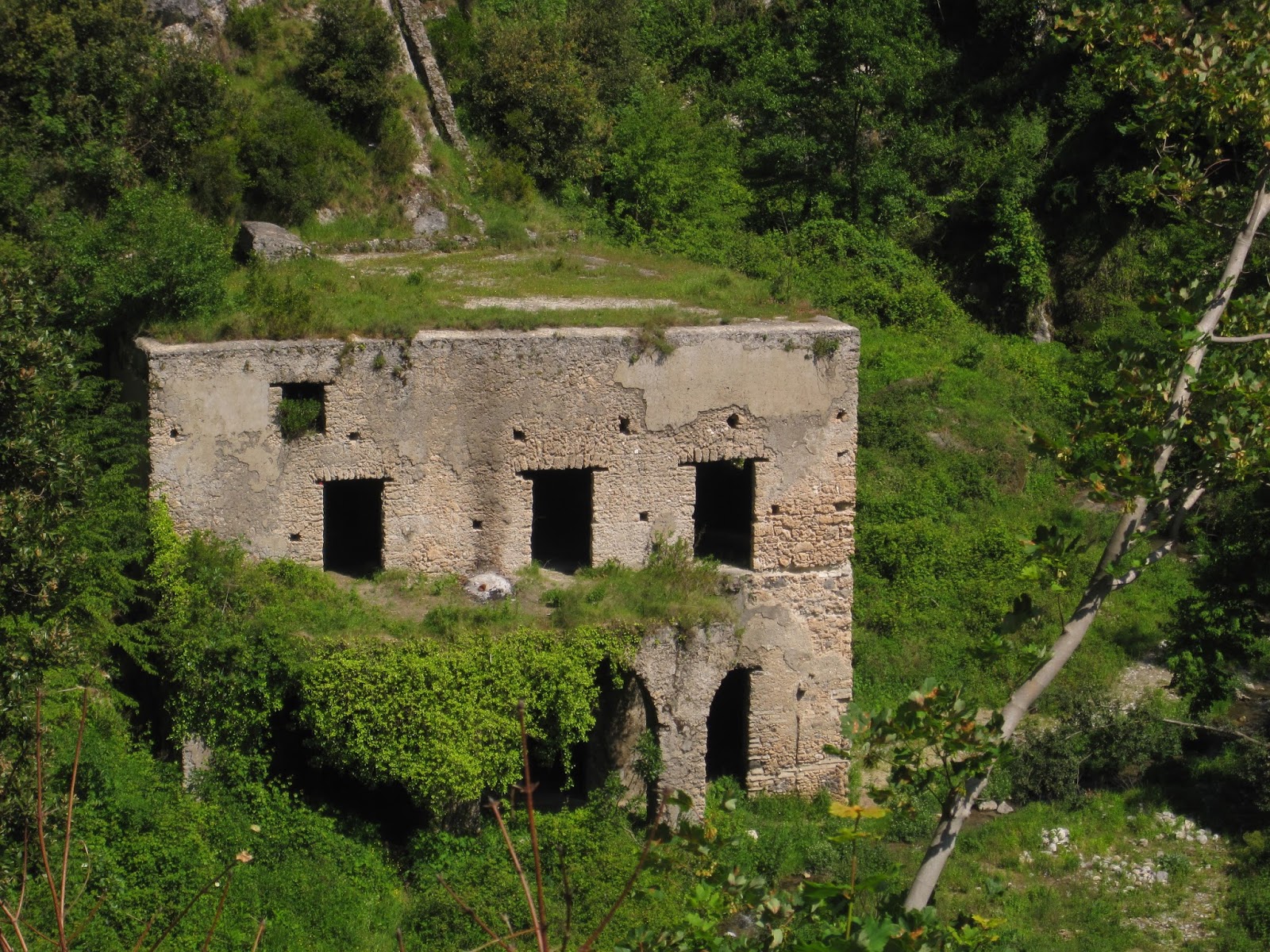
There would be no beach walks today, no crowds of ogling tourists.  We were heading out on a long walk up the valley behind Minori, following a little river high up to its source in the mountains behind this seacoast town.  We climbed up the tiny main road out of town to where it began to to turn back on itself and die out.  Very suddenly I felt myself as if on the set of an old Wim Wenders movie.  The hulk of some decrepit old mill blocked our way.  The building was at least two hundred years old, long since abandoned for its original purpose.  Now it seemed to be a squatters camp, complete with chicken coops, goats, and horses stabled against tumbling stone walls.  A young Italian guy slipped out from behind a wall, leading an unsaddled horse.  Without a word, he vaulted onto the horse and rode past us.  Unhindered and unaided, we found the trail hidden behind the old mill building.  We threaded our way through the camp and began to climb along the creek, quickly disappearing into groves of lemons on a hot spring morning awash in the heavy scent of wildflowers.  

The trail wound ever up the valley, past more lemon groves and the remnants of villas long abandoned.  The way alternated between stairs, long sections of gravel and dirt paths, and flagstoned walkways.  Our route was lined with star jasmine, wild orchids, and many wildflowers we could not identify.  It was a riot of color and aroma.  And not a soul on the trail.  We met one Italian woman on the way up the valley, exchanged greetings and avoided her three annoying little dogs.

The trail doubled back on itself at a tiny hamlet nestled into the upper folds of the valley.  We refilled our water bottles at one of the public spigots set into a stone wall, a lovely convenience.  From this small collection of houses hung from the hillside, we crossed the creek and thence a saddle at the top of the climb.  From here the walk led over the next ridge, climbing to a Convent on a rock outcropping overlooking the sea.  But we had kilometers to go and things to discover.

  There seem to be two lizards for every stone step.  They skitter everywhere, including over your feet and hands as they try to dash away.  Not the brightest of creatures, but very fun to watch.

Along the trail to the Convent, we began to see tiny ruins scattered on the hillside above us.  I investigated and discovered what appeared to be monastic cells, single room dwellings for monks or nuns.  As we continued, we found the ruins of a monastery or convent at the intersection of two trails.  It was a wonderful spot for a break, so we wandered about, exploring the ruins.

Yours Truly lounging about on the ancient walls.

Here is a link to a video I shot while goofing off:


The trail wandered along the ridge and climbed to the promised Convent.  There we found a small group of very sweaty Brits, hiding from the sun.  The Convent was less interesting than the ruins, so we left it to the Brits and continued on our way.  The trail wound down the ridge and broke into the open, gifting us views of the coast.  Below us was Maiori, the next village down from ours.  Larger and busier than Minori, it is still a charming place.

From here the trail became steep steps, descending with a vengeance.  We dropped through tiny hamlets hung over the sea, independent villages that date back to the 11th century and are still accessible only by stone stairs.  The old folks here must have the constitution of mountain goats.   We plunged our way back down to Minori, thighs and calves burning from applying the brakes.  

Hiking the Amalfi coast is hungry work.  We finished off the afternoon with a late lunch of salad and Saltimbocca, a pizze folded in half and cut like a quesadilla.  Just the thing for replenishing those lost calories.  Then it was off to the balcony to enjoy a good cigar and watch the crazy motocilisti race up the coast road.

Another magical day on the Amafli Coast of Southern Italy.  Today was a fine reminder that if a traveler is willing to make use of his legs and expend some effort, solitude and wonder can be found, even amidst this busy tourist destination. 


Wednesday, May 18, 2016

The Stairs to Ravello

Travelers and writers have been gushing over the Amalfi coast for more than a century.  I don't flatter myself that I will add any new insights to their torrent, but perhaps, perhaps.   Tourists have frequented the Amafli coast since the mule and cart road was built circa 1865.  My first bit of important information is that the road has not improved much since then.  Traffic, however, has increased dramatically, including the addition of lots of buses.  I am sure the road was a pleasant albeit dusty trip in the 1800's.  It is still a very scenic route, one of the most spectacular coasts roads in the world in fact.  So, here is the first of our helpful hints:  Do not drive the Amalfi Coast Road.   You may ask: Why Not?  And I would answer thusly:

May is still the off-season in this part of Italy.  Regardless, the normal load of traffic on the coast road is far more than it can bear, what with buses, rental cars, locals, motociclisti and scooter maniacs all vying for space at the next hairpin turn.  And there are many, many hairpin turns.  Below the hairpin turns are sheer 500 foot drops to a pristine azure sea and very pointy rocks.  I cannot imagine what it is like in the high season.

Point One:  Leave the driving to someone else.  The bus ride will be more than exciting enough.  Really.  The public bus from Salerno is a mere 2.20 Euro.  Nothing in Disneyland comes close.

Before the cart track was built, folks could only get here via boat.  They still come by boat, thousands of them at a time, disembarking from the cruise ships for a few hours.  That brings us to...

Point Two:  The Cruise ships only dock in the port of Amalfi.  That is, in the actual town named Amalfi.  Cruise ships with lots, and lots of tourists.  There are a lovely string of very cool and charming villages scattered along the coast, all of them linked by cheap public buses and free but strenuous trails (more on that in a bit).  So, given the above, choose your accommodations with care.  Oh, the town of Amalfi and its posh uphill cousin, Ravello, are the most expensive on the coast. 

Point three should seem obvious:  Don't travel here in the high season.  It gets very, very hot.  It gets very, very expensive.  It gets very, very crowded.

But today, it is not the high season.  Today, we are walking up, up, up, out of the amazing village of Minori, climbing the thousands of stairs that go up (and down!) to Ravello.  To enjoy hiking here is to embrace the climbing of ancient stairs.  I can tell you, without exaggeration or hyperbole, that you will be trodding flagstones laid down many generations before you were born.  Many of the paths are centuries old.  Hiking the Amalfi coast is a magical experience of threading the labyrinth of history, charm and incredible scenic beauty.  And you are going to have to work for it.


Ravello is up there.  Minori is down here.  Terraced into the hillsides are the lemon groves which yield the most important crop on the coast.  During parts of their growing cycle, the lemon trees are covered with the green fabric that you see draped across the terraces.

It is a very steep landscape, all mountains, valleys and seacoast.  The Amafli is cut off from the north by mountains that block access to the Gulfo di Napoli.  To the south is the Gulfo di Salerno.  Everywhere else there are very steep hills, rocks and stairs.  And vistas, amazing vistas, the kind of views that incite dreams of selling everything to raise money to buy a tiny stone hut on a terraced lemon grove.  Get a grip Byron, the madness will pass.  Keep walking.  

Culture shock.  What else does one need after a hard stair climb?

Thousands of stairs later, high above the jeweled sea, lies the cultural and pretentious little village of Ravello.  Very expensive shops and restaurants, tourists who arrived here via taxi or bus, and a very, very impressive concert season with venues scattered amongst the to-die-for villas make up the offerings for the tourists.  This is the spot for the well-heeled traveler, the posh, the folks who flock to Chang Mai in northern Thailand.  From spa to yoga retreat to classical music, it's all here.  And, in fairness, it is very, very beautiful.  

One of the many vistas from the village of Ravello

Let us suppose that you have tired of the shopping scene of Ravello and wish to journey on.  Back onto the trail of stairs and, I assure you, the tourists disappear.  An even steeper section of stairs, rough and broken in places, drops down to the town of Amalfi.  We trod the flagstones, knowing that we would be climbing part of this on the way back to Minori.  Ah well, in for a cent, in for a Euro.

The drop to Amalfi and the craziness of the coast road.

The villages of the Amalfi coast are quiet during the off-season, slow and sedate.  Amalfi itself is much busier.  We spent an hour or two watching the people and restoring ourselves with a strict regimen of gelati consumption.  When we had had enough (the town is splendid, not to be missed, and very popular) we began pioneering our own route back to Minori, ignoring the tourist map that suggested we climb back to Ravello.

The quiet rewards of the simple paths will be evident as one walks by.


The further village of Maiori lies below us, while Minori is hidden beneath the dropoff.  Vistas open and close without warning, taking ones breath away.

A typical walk approaching one of the hillside hamlets.  Besides the runing of electricity, nothing much has changed here.  

Here is a little video of one of the small hamlet along the way:


One day of climbing the Amalfi coast and I was hooked.  A hiker can pop into a bustling town, enjoy or not, and disappear with a few steps.  I can assure you that the off-season will yield solitude should you seek it.  The climbs are strenous and well worth it.  One day of walking will convince you that there is a lot here to gush about.

Ciao for now!


Friday, May 13, 2016

Time Vortex

San Marco, southern Italy

Like everything else here, the wifi is very slow, so slow I am unable to post any photos. Life here revolves around breakfasts of pastry and Espressi, long walks, and evening cigars down at the little harbor.

I will catch the blog up when I can.

Ciao for now!
Marco