Wednesday, February 21, 2018

Commodities


Bozos and Bozettes in the wild

It was a day to leave the tobacco fields behind. We boarded the Bozo Bus, traveling west and then south. Our destination was Matagalpa, the heart of Nicaraguan coffee country. The town of Matagalpa is perched at an elevation of 2,300 feet. Rising on all sides are the steep slopes of cloud forests where coffee is grown. Below the town, in the sun-baked lowlands, are the Beneficios. At the Beneficios are the huge drying patios where wet coffee beans are sun-dried, sorted, and bagged.

Coffee fruit are harvested by hand, processed, and washed at the farms. The wet beans have to be transported to the drying patios before the beans begin to mold. The beans have to be on the patios within twenty-four hours of coming out of the soaking tanks. It is harvest time in Matagalpa. Rickety trucks chug up and down the steep hills, each laden with a full load of wet beans. The heavy bags are carried from the trucks by hand, thrown down on the patio to break them open, then the beans are raked out flat. Almost every step of the process is hard physical labor.

The Bozo Bus labored up the steep slopes above Maltagalpa while the beans made their journey down the mountain. We passed an old Soviet tank on the side of the road, a reminder that this area was yet another battlefield during the Sandanista Revolution. The coffee farm that we were traveling to has been subject to the tides of that war. The land was taken from the owners following the revolution. One member of their family was murdered (or assassinated) in Managua. Eventually, they were able to recover about thirty percent of their farmland.


Our oasis in the Cloud Forest

Leaving the bus to fend for itself, we climbed the manicured pathways to the guesthouse. Perched on the top of the mountain, there are sweeping views of the valleys below. Clouds swept over the mountaintop, drenching everything with a fine rain. Sun, clouds, rain, more sun. Welcome to the cloud forest, and the nurturing cycle for the coffee that is grows under the shade canopy.


HIdden paths

We smoked, we lounged, we ate, we talked. It was a day for lazy reflection and conversation. When the rain blew in, the hearty few huddled under cover while the rest retreated to the warm fire burning in the guesthouse. Some of us even worked a bit.


Scribbling above the clouds

But all was not fun and games. After lunch it was time for coffee cupping. The process of coffee cupping is a slurpy, noisy affair. The ground coffee is dumped in a cup, water of the correct temperature is poured over the coffee, and the process begins. First comes the sniffing of the coffee samples, then breaking the "crust" of floating grounds, then the slurping of coffee from spoons. This is the method coffee tasters and buyers use for determining what beans they will purchase. 
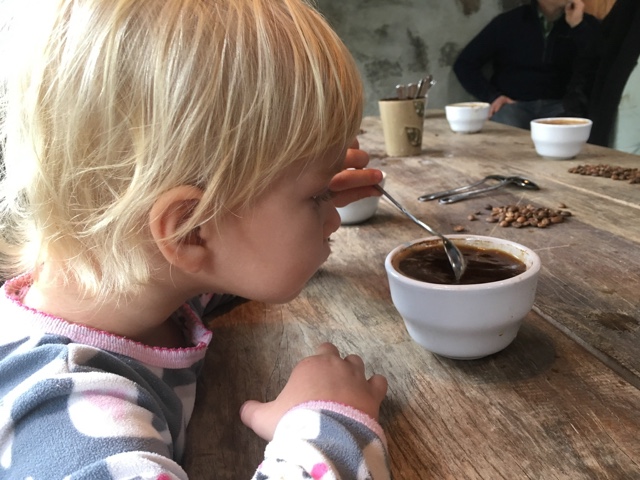

The world's youngest coffee expert.

Some folks trooped off to see the farm and its processing shed. The rest of us took on the task of being lazy sods. Regardless, I believe a good time was had by all. It would be difficult to not enjoy oneself in such an idyllic setting. Even the crapper had an expansive view.


In the running for Great Toilets of the World


Coffee is not the only crop grown here.

Eventually we had to depart from our perch in the clouds. The bus ride back to Esteli included a long discussion on the commodity of coffee, including the state of workers, farmers, and coffee brokers. We weighed the merits of Free Trade, coffee co-ops, and the like. While the discussion ranged here and there, my thoughts turned to the basic commodity model of colonialism.  

From my point of view, the colonial system serves a very simple purpose. A richer and more powerful nation takes over a poorer and weaker nation. The colony established, the colonizer tries to extract all of the moveable resources of the colony at the cheapest possible cost. The colonial power reaps the benefits of the commodities, and the colonized people suffer. The inhabitants of the colonized nation or region become the cheap labor that performs the extraction of resources. 

Prior to the 'discovery' of the New World, the good folks of the Old World did not have coffee. How the hell they woke up the morning is still a matter of historical debate. Along with cacao (as chocolate) and tobacco, coffee would have a dramatic effect on the colonizer. 

Coffee houses sprang up in Merry Olde England, which was not so merry at the time. By the early 1600's, coffee houses were gathering places for disgruntled citizens who had enough money for the luxury of the brew. The royalists were pissed off at the parlimentarians and vice versa. The opposing sides would gather at their respective coffee joints, get jacked up on caffeine, and proceed to foment political plots. The result was the beheading of a king, the rise of Cromwell, and a good old English Civil War. While all these events may not be directly attributable to the availability of coffee, there are many historians who include coffee as a contributing factor. Take that, you pesky Colonizers!

Here is simple experiment: Try to get a decent cup of coffee in Nicaragua. It is very difficult to do. The beans that are left for domestic consumption are the dregs of the crop, the grades that no foreign buyer wants. Almost the entire Nicaraguan coffee crop is exported to foreign markets. What is also exported is the lion's share of the value inherent in the commodity of coffee. Once the unroasted beans leave the country, all of the value stored in the commodity goes with them. The profits that come from brokering, shipping, roasting, packaging, wholesaling, and retailing the beans, benefit the importing countries.

Jumping up on the Reverend Squeaky-Eye soap-box for one short paragraph, I will perform a quick rant. If you care to make a difference in the way commodities you consume are extracted from other nations, do your homework. One can, for example, purchase and consume coffee that is roasted and packaged in Nicaragua. In doing so, you support the Nicarguan folks that ship, roast, and package the coffee. You help create jobs for Nicaraguan folks that produce the packaging. In other words, a larger percentage of the inherent value of the commodity of coffee stays in the country of origin. Thus endeth the rant.

The Bozo Bus chugged into Esteli. Dinner was consumed, and Zee Germans were re-engaged. The night was long, the rum beleaguered, and dead soldiers accumulated. I retired before the finale, but from the collective suffering apparent at the next morning's breakfast, the rum wars were fought to a draw. It was a lucky thing for the battered celebrants the day to come was a free day, a day without agenda, a day for nursing a wicked rum battering. 

From the infamous Hotel Los Arcos, Esteli, Nicaragua: Ciao for Now.


Tuesday, February 20, 2018

Esteli without Cigars


El Brujito, the Shaman emblem of Esteli, Nicaragua

Okay Blogger Boy, try to do a complete post without mentioning cigars. I dare ya, I double-dog-dare ya!  Challenge accepted you rotten voice-in-my-head. (Psst... They're reading this. Oh, right, sorry. Ahem.)

Villa de San Antonio de Pavia de Esteli is the full name of Esteli. Through the town runs a river of the same name. On the far side of the river, folks discovered a series of prehistoric petroglyphs chipped into large rocks. One of these, now named El Brujito, was adopted as the official emblem of the city of Esteli.


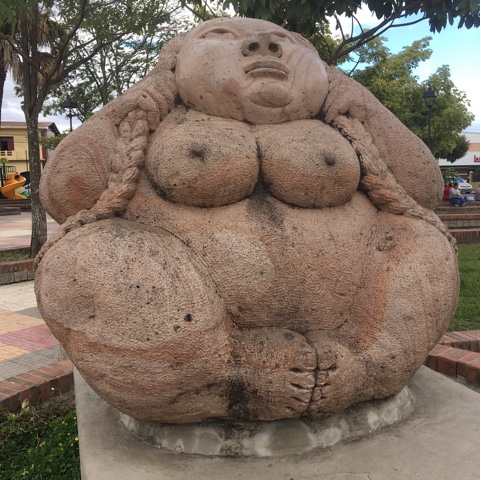
The Fat Lady ain't singing.

Another of the petroglyphs was the basis for this sculpture, located in the very fine central square. The square is the site of food vendors, lounging locals, and kids frolicking on the playgrounds. This is the spot from which to start any good Esteli walkabout. Located less than one hundred meters from the infamous Hotel Los Arcos, I crisis-crossed the square on most of my outings.

Esteli is situated in the northwest portion of Nicaragua, near the border with Honduras. It shares a political and cultural legacy with the liberal faction of the north, as opposed to the conservative faction of the south. It is another part of the Leon versus Granada history that has caused the country grief. During the Sandanista Revolution, grief came to Esteli in a big way.


The Battle for Esteli

In 1978 and 1979 there was heavy fighting in and around Esteli. The forces of the government, the Somocistas, were fighting against the revolutionary Sandinistas. The Somocistas, the conservatives, were fighting to maintain the dictatorship of Antonio Somoza. They held a particular animosity for Esteli, which they considered a hotbed of insurrection. The city was shelled with artillery, bombed from the air, and assaulted with infantry. Over the course of the hostilities, about 15,000 people were killed. This includes young men who the Somocistas massacred, based on suspicions that they supported the revolution. Following the eventual victory of the Sandinistas, the city was rebuilt.


Ash Wednesday in Esteli

Esteli is a busy town. There are a great many jobs involving the industry that we will not name in this post. As a result of those worker's wages, Esteli is a thriving, busy, noisy mercantile center. Loudspeakers blare from shops, hawkers sell their wares on the street, and workers look for bargains in bins of clothing. It is all noise and color and frenetic energy. Venture off into the side-streets, however, and Esteli is a place of narrow lanes and sleeping dogs.  


The Esteli River, dry as a bone.

If you like chicken, rice, and beans, you will love Esteli. Nicaraguan cuisine is not one that folks usually rave about. That you will get plantains with every meal is a given. Let's be kind and call the local grub earthy. Yes, that's it, earthy. And filling.


My favorite street-food stall.


Pollo, hand-made tortillas, pico de gallo, and a smidge of slaw. What else do you need?


Still hungry? Heavy, sugary pastries are but a stone's throw away.

Speaking of the shops in Esteli, you may see someone wearing a T-shirt emblazoned with "New England Patriots -- Super Bowl Champions 2018." Wait, that's not right. But the Third World is where rejected clothing goes on to have new life. I have seen farmers in Laotian rice fields sporting shirts celebrating a Texas family reunion. How did such a shirt find its way here? The answer is simple: bulk clothing brokers. These folks buy up whatever rejected clothing they can find. The super bowl shirts printed for the losing team are a fine example. Bought for pennies a pound, the clothing, towels, whatever, are baled and shipped to other markets. Whole shipping containers of these bales end up in poor countries around the globe, where they are sold to folks who need cheap shirts. 


Bales of forgotten First World goods.

There is one reason why folks in Esteli are able to buy goods, and that one reason is the industry we are not mentioning in this post. The current population of Esteli is estimated at about 130,000 people. That is the polulation of the town. The department, or state of Esteli, is somewhere in the neighborhood of 230,000 people. In the city of Esteli, about half of the folks are directly employed in one industry. That industry makes you-know-what. Virtually every other business in the town provides goods, services, or material to that same industry. 


An evening walkabout can yield amazing sights. The gloaming of the day on a quiet Esteli street becomes, for a magic moment, a tableau of glowing red. Uniformed school children make their way home to dinners sure to contain a plantain. I stand mesmerized in the fleeting glow.

It is a pretty cool town. And I finished the post without mentioning you-know-what. Take that evil-voice-in-my-head. Until next time, and more of Nicaragua, Ciao for Now. 


Cigar-Town


Brekkie Esteli, complete with green vege.  Alert the Media!

The dining room of Hotel Los Arcos resembled an infirmary. I kept my morning chiperness in check so as not to be set upon by the sufferers. The story came out in bits and pieces, interrupted by multiple trips to the coffee urn. Zee Germans. Our group had met Zee Germans. It seems that the rules of engagement between our two cigar groups were these: 
1) No Bottle Placed on Any Table May Remain Unopened
2) The Engagement is NOT COMPLETE Until All Opened Bottles Are Emptied. 

Our brave Bozos gave as good as they got, but there was a price to be paid and they were paying it. They had to pay it quickly, because the bus was due to sweep us up at 8:30 in the AM. Hi-Ho my poor beleaguered hearties, slug the Java down!


Do not manipulate the Tortugas! (No Manipular las Tortugas!)

Throughout its existence, Esteli has been a farming and trading town. An isolated village built in an ancient volcanic valley, time moved slowly in Esteli. That all changed with the coming of the Cuban Revolution. As the revolutionaries battled into power, some of the Cuban cigar-makers fled their island home. They took their tobacco seeds with them, hidden in the hems of their clothes, the bottoms of their bags, or in their socks. This Cuban diaspora fanned out across Latin America, searching for the proper soil in which to recreate their beloved tobacco leaves. In the rich, black volcanic soil of Esteli, the Cubans found what they were looking for. They began cultivating Cuban tobacco in the Esteli valley.


It's all about the Leaf. Tobacco, Esteli, Nicaragua.

The Bozos, both living and walking-dead, managed to make it onto the bus and out into the world. Our very first stop was one of the A.J. Fernandez farms. Start with the leaf Baby! We tripped around the greenhouses, saw the tiny tobacco seedlings, baked in the sun along the edge of the fields, ran our fingers along the lush surfaces of the tobacco leaves. For many of us, this was not the first rodeo. We had visited this very farm four years ago. In that time, great gauze nets have sprung up over some of the fields. Shade grown tobacco is becoming an important part of the Esteli crop.

For some folks it may seem that tobacco is just tobacco. It is a plant that folks smoke. And that would be true. But each region, and even each farm in that region, produces tobacco with certain distinct flavors, and strengths. Soil, weather, elevation, and type of seed all make a huge difference in the characteristics of the tobacco. Tobacco is harvested in what are called Primings. Where the leaf comes from on the plant has a huge impact on what the leaf is used for. Seco, the lowest leaves, burn well but have less flavor. Viso, the middle priming, has more flavor and strength than Seco. Ligero, the uppermost leaves, have the most strength and strong flavors, but they burn poorly. There is a lot more to this cigar business than sticking some tobacco leaf in a bunch and twisting it up.


The Pillion

Reduced to the simplest processes, tobacco is turned from green leaf to smoking material in a series of steps. The leaves are harvested in Primings, then tied into 'Hands' of twenty-five leaves each. The hands are then hung in drying barns. When the tobacco hands are sufficiently dried, they have to be fermented to bring out the sugars and oils in the leaves. That process happens in the 'Pillion' which is a very carefully monitored compost heap. The hands of tobacco are rotated in the pillion from top to bottom and inside to outside. The temperature reaches up to 150 Fahrenheit. Too much heat and water and the tobacco molds or burns, too little and it can rot. It is a tricky business and I am making it sound far simpler than it is.


The Divas of Sorting

On its long journey, tobacco leaves are touched by many pairs of hands. The lowest estimate I have heard is three hundred individual folks. These are the hands that harvest, handle, wash, bunch or roll. It is harvested, hung in drying barns, fermented in pillions, rotated in the pillions, washed, shaken, de-veined, sorted, aged, re-sorted, and all of this before it ever sees the production floor. At each step, at each transport, it is carried by hand, washed by hand, sorted by hand. Labor is cheap in Nicaragua and machines take jobs away from people. Even at the loading dock, cartons of finished cigars are loaded into trucks by hand.


The final product nestled in the aging room.

Yes, yes, you say, but enough about the tobacco. How fare the Bozos? Ah, yes, the Bozos and Bozettes filed dutifully through farm and field. Some were eager and chipper at the front, some slow and suffering at the back. The off-gassed ammonia from the curing room brought watery eyes and coughing, but the brave Bozos shouldered on. Okay, in truth, some of them fled from the room like cowardly bunnies. But they were all standing at the end of the day.

We toured high, we toured low, we smoked cigars, we had lunch. By late afternoon our dogs were barking (which translates to sore feet for you civilians).  Dinner concluded, it was time for camaraderie, cribbage, and cigars. For some of the more stubborn Bozos, it was also time for re-engagement with Zee Germans. Those poor rum bottles did not stand a chance.

And I retired to my room before being swept too far into the late-night madness. There was far more merriment to come and all of it at a price. Tomorrow would bring more shenanigans in Cigar-Town and I needed to be ready. 


Monday, February 19, 2018

Los Bozos van al Norte (The Bozos Go North)


Pico de gallo, queso, huevos, y tortillas. What else does a hungry Bozo need.

Back in 2014, this same group of Bozos, plus or minus a few members, were assembled in Nicaragua. I suppose that makes this the Bozo Redux Tour. Regardless, we find ourselves here in Granada, Bozos and Bozettes. Today was a walkabout day before the long drive from colonial Granada in the south to the working city of Esteli in the north. Nicaraguan brekkie is the foundation of any good day of travel, and so we indulged before walkabout.

The day was hot and the sweat was rolling, perfect weather for a stroll. The whole Bozo cotillion assaulted the square. It was as if the US Marines were landing to protect the interests of United Fruit. We toured the cathedral, viewed the newly-painted frescoes, climbed the bell tower. One of the frescoes included an image of a panda bear, another a biblical fellow cradling a tiger, all painted in almost day-glo colors. It was a sight.

Given the option of a bus ride back to the hotel or a bit of walkabout, I chose to ambulate. A few stalwarts joined me, despite the heat. Down market and up cobbled hill, we serpentined our way back just to the hotel, arriving in time to load up for Esteli.


Paul Klee's Unknown Granada Period

Glorious patches of colonial chromatic color left behind, the Bozo Bus plowed north, past volcanoes, past lakes, past the skinniest horses in Central America. We smoked, we joked, we dozed. Yes, in Nicaragua one can smoke cigars on a bus. At least on our bus. Damn the torpedoes and New-Age panda savers.

We pushed past Managua (all roads lead to Managua) and continued north, beginning the climb into the mountains. Playing tag with the long-haul trucks on the Pan-American Highway, we ground along as best we could. The spleandor of colonial Granada had long since faded to the workaday reality of Nicaragua. 

This is the poorest country in Central America. The nation is half the size of the US State of Nevada and supports a population of 6.2 million folks. NIcaragua has suffered at the hands of many. The Spanish Conquistidores, and the Haciendo system that followed, did much to shape Nicaragua. The country was absorbed into the First Mexican Empire in 1821, not becoming a sovereign nation until 1838. Civil wars wracked the country in the middle of the century, fought between the liberal north and the aristocratic south. It was Leon versus Granada. Nicaragua even suffered the indignity of William Walker, a Gringo, declaring himself president. Revolts were followed by counter-revolts, the heavy-handed tactics of United Fruit, and intervention of the US Marines to back the fruit corporation magnates. Trouble followed NIcaragua into the Twentieth Century, despite the yearnings of revolutionary poets and working people. The Somoza family made Nicaragua their own little piggy bank. The dictatorship was a family affair, continuing until the Sandanista Revolution in the late 1970's. The workers and campesanos of Nicaragua have never gotten an even break.

The Bozos on the Bus climbed higher into the mountains. By nightfall we had arrived on the outskirts of our destination. Esteli, once a dusty town on the Pan-American, now the cigar production Capitol of Nicaragua. There will be far more to tell about Cigar-Town, but for us it was a welcome sight. We rolled into the Hotel Los Arcos, infamous to all in the Nicaraguan cigar trade. Bags were stowed, bottles of rum unstowed, and general merriment unfurled. The rest of the night, well, what happens at the Los Arcos stays at the Los Arcos. 

Besides, the Bozos are here for the week. There will be lots to tell, even if I have to give out the names of the innocent. 

Meeting the Tribe


Breakfast Managua-Style

It was a lazy morning, a sitting around morning, a watching the birds morning. My airport transfer was at 11 AM, and I had no flight to catch. My only mission for the day was riding the short distance to the Augusto Sandino Airport to meet the incoming folks. Fifteen Bozos and Bozoettes reuniting for another tour of Nicaragua's cigar industry. Given that a dozen of us had done this prior, you'd think we would have learned our lesson.

And so it was a lazy morning, and verily I did sit around, eating, drinking coffee, smoking, and watching the birds. At the appointed hour, I loaded my crap in the little SUV and was schlepped over to the airport. We did not, however, go directly to the airport. There was an unscheduled stop when the GPS security sensor shut down the SUV 100 meters from the hotel. My driver had forgotten to flip the secret switch. Such are the small details of life in Managua.

We slipped from the quiet of the barrio to the chaos and cacophony of the Pan-American Highway. Dodging the death-dealing trucks and buses, we arrived safely. Now came the gauntlet of porters, taxi drivers, and tour shills. 

"No, gracias, no necesito asistir." Again and again. The simple act of a porter laying a hand on a bag costs a buck. If another porter manages to lay a hand on your bag, that's another buck. If they have the opportunity, the happy porters will hoist your bag on their shoulders and parade it around, "Hail the Conquering  Hero!" All the while your tab is running up. Falling into the clutches of the taxi-porter cabal can only be avoided with ninja-like skills. Fortunately, I have spent many years learning and perfecting this avoidance technique. I led them a merry chase, up and down, from arrivals to departures and back again. 

I found the first of our party and we retreated to the far side of the airport road for a reunion and a cigar. The arrivals, from Seattle, Portland, Ecuador, and Nicaragua, were spread out over two hours. Eventually the cadre was complete, the bus arrived along with our Cigar Guru. We boarded the bus, Bozos One and All. The driver headed south, bound for the colonial town of Granada. The game was afoot.


Granada Street Scene

Granada is a colonial city nestled onto the shores of Lake Nicaragua. Historically aristocratic and conservative, Granada is the rival of Leon to the north. While they once battled for control of Nicaragua, the two cites now battle for the tourist dollars.

Colorful cobbles streets, colonial plazas, Granada has what the tourists want to see. We arrived in the town, stowed out gear, and fell into a reunion of cigars smoking and tall tale telling. The opportunity for a walkabout was looming large. Two of us slipped out of the hotel and set about the streets. 

The center of Granada is the cathedral and the central plaza. From there, a walking street leads down to the lake, threading past a throng of waiters waving menus. The cathedral and promenade serve to suck most of the touristas into a concentrated mass, thus rendering them very easy to avoid. Two blocks off of the main streets, we wandered through the early evening.


The Essential colors of Granada.

Tiles, cobbles, vibrant color, sun-blasted brick, that is the mosaic of a Central American colonial town. Mind your step while walking, lest you adorn your shoes with dog droppings or, worse, step into one of the many sneaky sidewalk holes. A late night stroll after a night of drinking can be a treacherous affair. Agility and awareness are requirements to survive a drunken stroll.


The Other Plaza

It was the gloaming when we found the other church, the working church. We watched the day slip away. On a hill above the tourist center, locals congregated, kids wobbled around on skates, hawkers sold ice cream and snacks. It was wonderful. We found a narrow passage down the hill into the old market, from where we eventually made it to tourist ground zero. Time to rejoin the Bozo Flock.


The Heart of Granada

We stepped out of the narrow market streets and into the buzz of the plaza. Nicaraguan Grackles were gathered in the trees, sending up a ruckus of chirps, squeals, and whistles. Tourists ran the gauntlet of craft stalls, some sporting fake Cuban cigars. Dodging the waving menus, we found our appointed cafe and settled in for a long, slow dinner. The street was a carnival of vendors, hawkers, and street perfomers, each trying to pry loose a bit of the tourist dollar. It was lovely. 

Worn out from the flights, most of the Bozo crew retired early. A few hardy souls managed a good session of tall-tales and nightcaps. So it goes and so it went. The first night of another Bozo Tour came to an end.


Thursday, February 15, 2018

Managua Walkabout


Local buses, Managua style.

A free day, an alone day, a day without goals or plans, these are the components of a good walkabout. My cadre of compadres was not due until the following day. I had an entire day to explore the sprawling Central American city of Managua. 

Not many tourists see Managua. There are some reasons for that. Not the prettiest city to begin with, in 1972 Managua was devastated by an earthquake. The quake destroyed a large part of the city, killing as many as ten thousand people, injuring more than twenty thousand, and leaving perhaps three hundred thousand homeless. Aid poured into the country and was promptly snatched up by the ruling dictator and his cronies. Anastasia Somoza and his pals gathered up most of the money and left the citizens to fend for themselves. Thus was Managua forever altered and the final seeds of the Nicaraguan Revolution sown. But that is the stuff of another blog post.

The metropolitan area of Managua is a sprawl of low slung building cast across a wide area. There are about 2.5 million folks living and working here. Getting around is tough, with the main form of transport being the smoke-belching buses that lurch through the snarl of city traffic. I love me a good bus ride, so I jumped aboard happily. Three Córdoba, about a dime, will allow you to transit the city and get in touch with your mortality at the same time. Our driver had a nice section of hardware store pipe for a shifter linkage. If he lifted up on the rag tied to the end, the entire homemade shifter arm would part from the floor. Things like this add a certain flavor to a good bus ride. After two buses and some help from the locals, I found myself in the dusty city center.


Revolutionary Heroes on the Street

The earthquake knocked down the tall buildings of Managua. It is a low-slung city. The wind rolls in off Lake Managua, sending dust devils dancing. Hot, dusty, windy, devoid of tourist "sights," there is a reason that Managua has few visitors. The interest, for me, is the reality of a busy, gritty, working city in Central American. There is no other way to see how real people live, than to plunge into the streets and experience it.


The National Palace and Managua Emptiness

I walked my legs off, starting at the southern part of the city center and working north towards the lake. What there was to see was made up of folks doing their jobs, students at the University, the windswept emptiness around a stadium, and lonely bits of park. At the northern end of Avenida de Simon de Bolivar, a traveler will come upon the wide spaces and parks that lead to the Palacio de National. Behind the palace is the ghost of the Managua Cathedral. Roofless, windowless, stone blocks cracked clean through, the Cathedral was the most famous victim of the earthquake. 


The Cathedral

Continuing on from through the greenery of the parks and myriad monuments to very dead revolutionary heroes, a stalwart walker will find himself on the promenade along Lake Managua. The wind whips whitecaps across the water, clouds dance around the tips of stout volcanoes, and the sun beats down. The place was almost devoid of humans, that strange emptiness of a beach resort in winter. The jetty, as well as many boulevards of the city, is adorned with huge metals sculptures of trees and flowers, which the locals call The Folly, due to their cost.


Managua Seawall

Finally worn down by walking, the sun, and the wind, I headed for the bus home. There are no gringos riding the city buses. Indeed, there are very few gringos at all. I stood out like sore thumb on a one-armed man. The locals were puzzled by my presence, but very friendly and helpful. The older ladies, in particular, were very concerned that I should get on the correct bus. With a little help and a little luck, I rode the belching beasts seven kilometers back to the barrio I was staying in. Disappearing into the barrio brought a welcome sensation of green and quiet. 

After a rest and a washup, it was time for dinner. I must admit that I failed in the endeavor. I ended up with a plate of carne asada and pico de gallo from which every trace of life and taste had been cooked. It is best forgotten, not to be mentioned again.

Most travelers to Nicaragua spend one night at a hotel near the airport, transferring on to other places the next day. Poor orphaned Managua, dusty and ignored. Can I recommend a day of walkabout there? Perhaps not. I enjoyed myself immensely, but there is nothing to point to and say "You must see this or that." If one desires to experience a real Central American city, warts and all, Managua is a good place to do so. If not, continue on to the colonial quaintness of Granada of the dramatic slopes of the many volcanoes. 


The Piper Calls -- Nicaragua


Winter -- Wien

One could understand why a fella might want to wander away from a Northern European winter. As much as enjoy living in Vienna, during the winter it is generally grim and gray. A person might want to go to, say, Nicaragua. That would look more like this:


"Winter" -- Managua

Hammocks, heat, you can see that it might be preferable. But to get there, well, one has to Pay the Piper.

This is a simple process for me. Not an easy process, but simple. Make a pile of goods, lay out the passport, stuff everything in the faithful Deuter backpack. When the pile is empty, I'm ready. But the twenty hours of transit, that is a different animal. As a veteran of many a long flight day, I have a few tricks. The first is to forget about relative time. The second is to adjust my brain rheostat to "Kid" setting. This helps a great deal. Being fascinated with the smallest detail makes the long hours on planes bearable. What IS this food? What is that little girl doing? What does this button do? You get the idea. Dwelling on the destination only serves to prolong the discomfort.  

Wien to Amsterdam, Amsterdam to Houston, Houston to Managua. A series of checkpoints along the course of the long day. Check bag, find gate, wait. Board the plane, wait. Quick transfer in Amsterdam, just make it, my name called at the gate. Not good. Extra passport check because I am a US citizen transiting through the US without stopping. Red Flag. Problem solved. Board the big plane, wait. Little kid in the row ahead, red alert. She turns out to be the flying angel champion of the world. Yay! Cute kid to play with, distraction. Surrounded by Dutchies, 25 young women on a youth group to Nicaragua. Laughing and giggling. Great! More distraction. Houston, US Customs, no problem. Four-hour layover, a great time to have a cigar and, as it turns out, a fascinating conversation with a Czech national who lives in Canada. Being involved in the process makes the process more palatable.


Houston -- Cigar Time Layover

So it goes. The magic is in the last flight. All the connections have worked, I am on the last flight of the day, and the next stop is The Destination. Thus it is the hardest flight. Landing in Managua, the interminable passport control at Augusto Sandino airport. One hour in line, feet aching. Finally the blast of heat as I step into the New World. There is the young Nica guy with my name on a placard. The last vehicle transfer of the day, thankfully complete, and I am in my hotel compound on a tiny backstreet of Managua. I am vibrating from the travel, in the zone of sleep deprivation and wired excitement. Sleep is not an immediate possibility. 

I sit in the heat and dark of a Managua night. The fridge yields orange soda which, when combined with a cigar, tastes like a Creamsicle with fangs. A poor choice on a normal day, but fascinating tonight. As the edges finally soften, sleep creeps up. Another epic travel day to add to the collection. They are long days, and hard, but the Piper demands his cut of the trip. I pay him gladly.