Tuesday, December 10, 2019

Myanmar Chapt. 11: The Small Travel -- Meiktila


It would be a day of small travel and unexpected destinations. My One was under the weather with a head cold, and not up for any marathon train or bus rides. We opted for a short jump to Meiktila, the closest real town-town from our base in Thazi. Ah, the luxury of not being in a hurry.

In Myanmar, as in much of SE Asia, the best short-distance mode of travel is the pick-up 'bus.' These open sided pick-ups or utility vehicles are called Songthaew in Thailand. They have hard wooden benches down either side of the bed, and a steel canopy above for luggage, extra passengers, or both. It is not a comfy form of transport, but it's cheap. The other thing to know is that the Songthaew are often the only form of transportation, especially away from larger cities and towns. I never did figure out the Burmese name for these contraptions. Folks just call them buses.


If you are in a seriously slow mood, there are always the horse carts. They may look like a romantic way to experience another era, but the horse carts are not here for tourists; not in Thazi anyway. The carts are pulled by small, scrawny horses. They are the same small breed of horse that pulls the carriages in Nakhon Lampang, Thailand. Local folks use them for short rides, and for hauling goods to the busy market. It's hotter-than-hot on the main street and the horses work hard. The drivers are not shy about applying a sharp flick of their goad to get the horses moving. My best advice to sensitive folks would be that the horse carts are prettier at a distance than they are up close.


It was a travel morning, so we lashed up the backpacks, hit the local tea-shop for brekkie, then wandered over to the Songthaew stop. Our morning journey was about twenty-five kilometers and the fare about seventy-five cents per person. There is no real schedule for the pickups. They leave when they are full. It is important to note that full is a relative term. Full, in First-World terms, means that every place on the ass-busting wooden bench is full. This definition of 'Full' does really apply in this part of the world.

A pickup bus is full when the benches are smashed full, cheek pressed to cheek, there are men hanging off the back of the truck, and eight small boys are perched atop the luggage on the overhead canopy. Even this state of fullness does not really mean completely full. The Songthaew will still stop alongside the road if someone raises their hand, palm facing down. Then more lumpy rice sacks full of goods will be tossed up, and somehow another body will squeeze in, defying the very laws of physics. What is more amazing to me is how people deal with it. Even when they get a bit grumpy about the conditions, folks usually laugh, smile, or roll their eyes.


Thus we came to Meiktila. There were no other Farrang crammed into the little pickup, and no Farrang on the streets of Meiktila. This is a busy town, a transportation hub, a provincial market town, and a university town. There are three universities scattered around the lakes that surround Meiktila. What Meiktila does not have is important tourist sights. Sure, there is the huge floating monastery shaped like a goose, but that's about it. Tourists do not usually stop here.

Meiktila reminds me of some of the favorite provincial capitals in Thailand, the type of small city that the Lonely Planet might give a pass. Therein lies at least the potential for hidden beauty and quiet travel. Like the aforementioned Nakhon Lampang, or Chiang Rai, Meiktila is a vibrant little city with a real life of its own. The town is not dependent on tourist trade, which makes it a good spot to experience how real life happens in Myanmar. It is a place for walkabout, without destination or expectation. This is a town where you will be noticed. Farrang on the street are a novelty. Open bus-loads of university kids will smile and wave at you. If you wave back, they will go crazy, laughing and giggling and shouting.


Phaung Daw U Paya is the big photo op in Meiktila. The huge floating barge is shaped like karaweik, a mythical bird. The original is a famous floating palace in Yangon. This is an iconic image in Myanmar. It is emblazoned on shop signs in every town in the land, on beer labels, and on Myanmar tea.


For my moto friends scattered across the globe: It is good to know you are not alone.


There is a specific style of colonial-era architecture in Meiktila that I have never seen before. Scattered amongst the newer shophouses are late colonial façades built in an almost art nouveau style. They are modest structures, only one or two storeys tall, stained by the black mold that are slowly eating them away. They stand as a decaying monument to Meiktila's past.

The history of this town has not always been a happy one. This was the site of fierce fighting during World War Two. The Burmese theater is often call the Forgotten War, overshadowed by the more famous battles in North Africa, Europe, and the Pacific. But for soldiers of many different lands, this was a very real, and very bloody battlefield. Meiktila was a strategic transport town, a key to the 1944 British-led offensive to recapture Burma. The town was heavily defended by Japanese forces, and the fighting was brutal and bloody.

Modern Meiktila has another sad legacy. In 2013, tension between local Buddhist and Muslims reached a critical mass, fueled in large part by animosity against the Rohingya people. A small spark ignited rioting and mob violence. When it was over, more than forty people were dead and many more injured. At least 9,000 residents were displaced by the violence. As I mentioned in an earlier blog post, the issue of displaced Rohingya is an ongoing problem for the Myanmar government.


One of the distinct customs of folks in Myanmar is the wearing of thankkha, an earthen paste that is applied to the cheeks, nose, and forehead. Like the purple-stained teeth of the betel chewers, it becomes a familiar sight.

The paste is worn over the face for cooling and for protection from the sun. The custom can vary from a child smeared with the stuff, to artful designs on the faces of stylish women. It is primarily a custom for women and children, both boys and girls. It is rarer for men to wear the thankkha. Many families make the paste at home, or buy it from a local producer in their village or town. It is very much a product of the region.


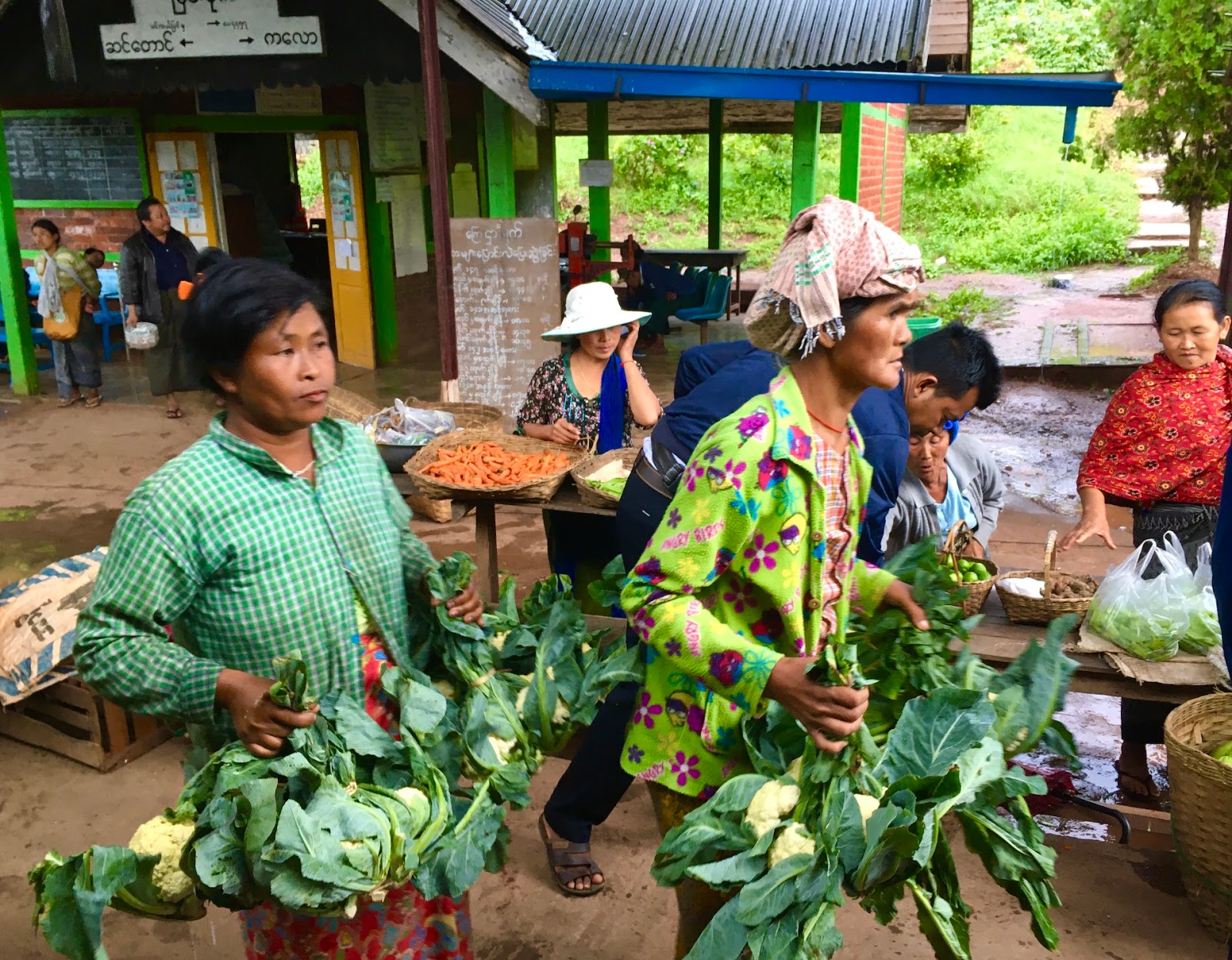
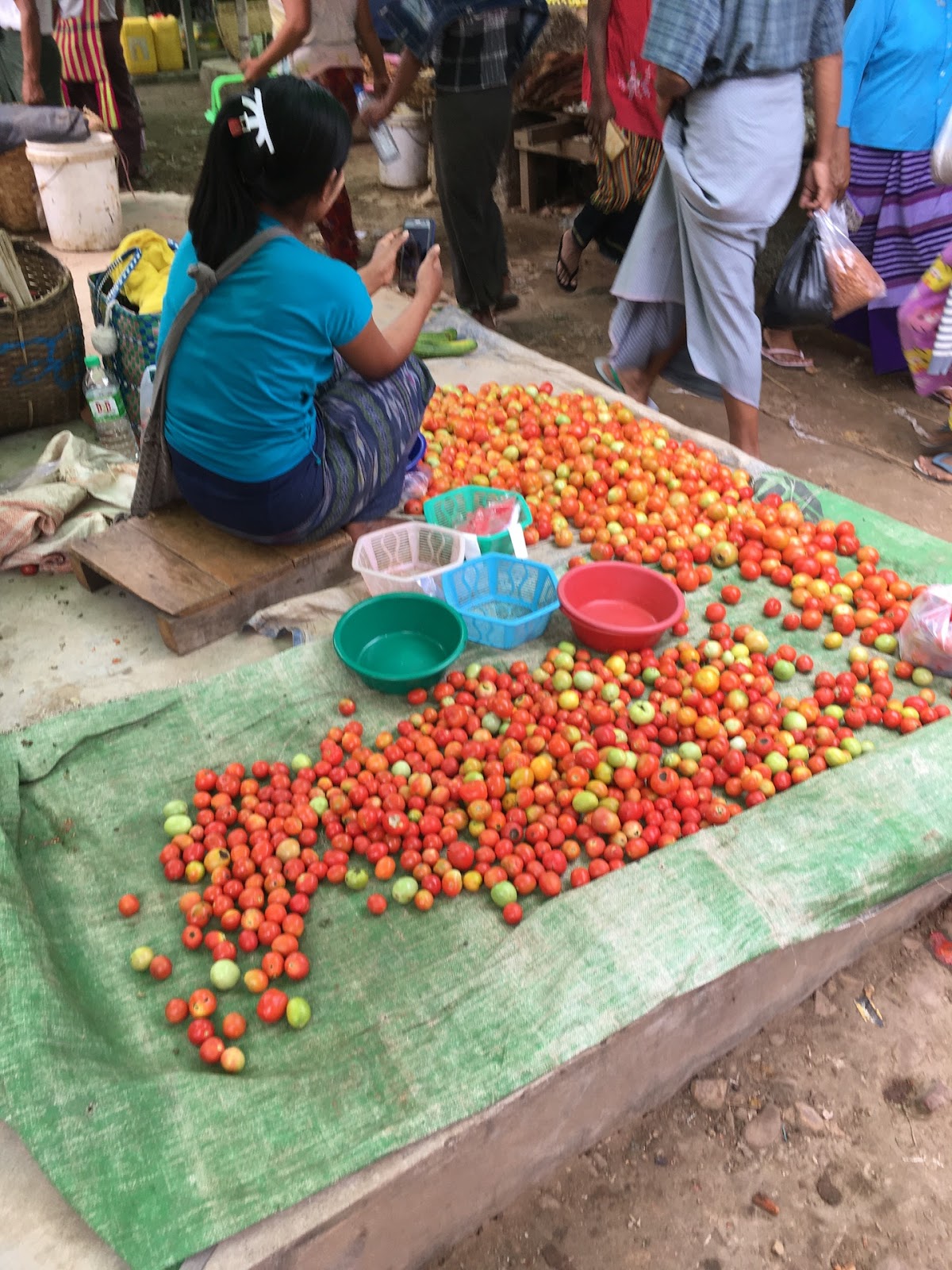
One might ask the question: So what did you do there? The answer would be: Nothing much in the sense of great adventure. Viewed through the close-up lens, we did a great deal. We wandered the sprawling market, ducked into tea-shops when it rained. The local folks hang out down by the lake shore, and we joined them. People greeted us and we greeted them. Meiktila offered us a good view into what normal everyday life is like in Myanmar.


And, of course, we ate. This town offered up the best Myanmar curry so far. The particular curry pictured above is a fish curry, complete with all of the ubiquitous side dishes.

Meiktila proved to be our pit-stop, a jog away from the more traveled ways. To be sure, the tourist trail in Myanmar is quiet this time of year, and always quiet compared to the well-worn routes in Thailand.

From here we would travel to Bagan, Temple Central, perhaps the most famous destination in Myanmar. Night and day, small travel and large, all of it makes up the journey. I was glad for a chance at the small travel.


Thanks for your interest in my travel blog. I do hope you enjoy it. If you liked what you read here,  please tell another reader. Word of mouth is the most precious gift an Indie Author can receive. 

How about a free short story? My short story "The Crying Man" has recently been featured at the great online journal Literally Stories. You can check it out here:

"The Crying Man" at Literally Stories

Or perhaps one of my other novels? All of the information is at my website:

Marco Etheridge Fiction

You can check out books, blog posts, book reviews, or even get a free book. Just look for the big button that says "FREE BOOK." It's kind of hard to miss. Happy reading!!

Thursday, December 5, 2019

My First Non-Fiction Piece Published!


I am thrilled to interrupt the travel blog for a special announcement! My first published non-fiction piece, "The Healing Sting," just went live on the great online journal Route 7. I am honored and grateful to the editors for choosing my work.

"The Healing Sting" is a memoir of childhood, and memories carried into later life. I hope you will take the time to give it a read, and to support the folks at Route 7.

The general link for the current issue of Route 7 is here:

Route 7, Issue 7

The specific link for "The Healing Sting" is here:

"The Healing Sting" at Route 7

Thank you for supporting Indie Authors, and thank you for being readers. Readers Rock!!

Very Best Regards,
Marco

Myanmar Chapt 10: The Real Slow Train

Shwenyaung, a Station from Another Time...


My Heart and I were up early, bustling around the bungalow, performing the last check for stray belongings. Out host had breakfast boxes ready for us, and a taxi was standing by. The plan was coming off perfectly. We needed to leave at 7 AM to ensure that we would be on the 8 AM slow train to Thazi.

The departure time was written in stone. Our smiling host had confirmed the time. The smiling woman at the travel kiosk had confirmed the time. The information on the internet agreed with all of the smiling people: Eight AM, Bubba. Be there or come back tomorrow.

The taxi whisked us away from Nyaungshwe, through the dusty streets and out onto the raised causeway along the lake shore. It is thirteen kilometers from Nyaungshwe to the train station in Shwenyaung. We did not know it, but at that moment our taxi was moving at a greater velocity than any other transport we would ride this day.


When we arrived at the colonial-era train station, everything was quiet. Too quiet. Before I could torture any more movie tropes, we found out why the station was so sleepy.

"No, train leave eleven o'clock today. No train eight o'clock."

Thus spake the most official looking of the clustered gents in the ticket office. There was no explanation, nor did I ask for one. What did it matter why? I was sure I could hear the soft snickering of the Travel Gods in the background. Welcome to a part of the world where schedules are theoretical.

It is 147 kilometers from Shwenyaung to Thazi via the twisty highway. The train takes a more circuitous route through the mountains, something more like 200 kilometers. That distance requires ten hours, twenty kilometers per hour, or about twelve miles per hour. When the three hour delay was added on, our arrival time in Thazi would be about nine PM. My Heart was not pleased, but there was nothing else to be done.


The first thing was to find a tea-shop. There is always at least one shop tea-shop near any station. Where else would the taxi drivers find a place to not work? This shop was a particularly good one. The owner was frying fresh Chinese donuts while his wife flipped and kneaded the dough. One of the sons plopped down our two cups, along with two piping hot strips of fried dough. Oh, hell yes! our total bill for two teas and two donuts: 800 Kyat (about fifty-five cents). We drank, we ate, we smoked, and time passed. There was a lot of time to spare.


Trains are Sneaky, Dangerous Things...


Back on the rustic station platform, there was nothing to do but wander around. I poked around old train cars, smoked a cheroot, and learned about all the many ways a train can kill you if you aren't paying attention.

Here is where this blog veers into a photo essay, at least until the train arrives. How much can one write about waiting in an empty station? Oh, wait, I forgot to mention the schadenfreude of passing on the news of the delayed train to the newly arriving passengers-to-be There was some fun to be had in that.


The Ruins of the Past...


What I took for an abandoned train wagon was, in fact, a working car. Not long after I took this photo, a train hooked up to the thing and hauled it off.


Our Train Cometh...


The sleepy morning air was broken by the long whistles of our approaching locomotive. Yes, our train had finally cometh. The thing was a rolling museum piece, it's true, but it was a bona fide locomotive, and the only one we were going to get.


Vintage Running Gear...


It is down here amongst the running gear that one gets a clear picture of how old these trains really are. I am here to tell you, Friends and Neighbors, this ain't no Johnny-Come-Lately machinery. This stuff here is the Real McCoy.


An Upper Class Wanderer...


After some shenanigans in the station, hand-loading piles of lumpy sacks and what-not, the whistle sounded again and our train lurched reluctantly to life. The little-train-that-might rolled across the last bit of flatland before the mountains. At the first slight incline, I was sure that I could hear the locomotive groaning in pain. Thus began our climb up into the foothills, up to the heights of the tea plantations that this train was built to serve. It was a long climb, and slow.

Words do not accurately describe our stately pace. I shot a few videos through the open window, videos which capture the awe-inspiring lack of speed our little train could sustain.

Here is the first video link, the train crossing a trestle with the snaky highway in the background:


Climbing out of Shwenyaung on the Slow Train


And here is the slow climb up the escarpment, the train curving back on itself through jungle and field:


The Real Slow Train: Shwenyaung to Thazi, Myanmar


The train stops in the middle of nowhere. It stops because there is only one track, and another slow train is coming from the opposite direction. It stops in any and every hamlet along the way. This is the market train. Piles of goods are loaded into the wagons, and other piles of stuff are unloaded. Lumpy bags of cauliflower, onions, and other produce are stashed in the aisles or behind seats. The Upper Class wagon is just as suitable for vege storage as the Ordinary Class.


Jungle scrapes the side of the car with leafy hands. Branches bounce along the roof. There is a train-sized hole punched through the jungle. The jungle grows back faster than the train wagons can knock it down. At first, the sound of a branch scraping the roof is alarming. After a few hours, one does not hear it anymore.

The train becomes a movie, a very slow avant-garde film that will take all the time it needs to tell a quiet story. We passengers aren't watching the movie, but rather we are in it: extras trapped inside the set of a few dilapidated train wagons. We are carried the length of a very long saga in which we play only the most minor of roles. Like Rosencrantz and Guildenstern, we are adrift in the long pauses  between speaking lines.


The folks that live in these hamlets are mostly Pa'O people. They are a Tibeto-Burman people who have inhabited this region for over a thousand years. The Shan State saw it's share of conflict with the former Myanmar Junta. Those armed conflicts drove many Pa'O people into the refugee camps around Mae Hong Song in Northwestern Thailand.

A gentle afternoon rain begins to fall. I see a few parties of Farrang trekkers slogging along steep pathways. They follow their Pa'O guides, pause on the long walk to wave at the train.


The arrival of the slow train is the big event of the day in these remote jungle hamlets. The train sits in each tiny station until all of the business is done, every last sack loaded, and the conductors have finished buying their snacks.

The evening is upon us, and we begin our descent from the mountains. The train has been snaking back and forth in sinuous curves, but eventually the slope becomes too steep. Our little train full of produce begins to zig-zag down the jungle mountainside. The trains stops on a siding, encased in a green tunnel of overgrown foliage. A switch is thrown, and we begin backing down the slope, descending the first zig. Then comes another siding, another switch, and we are moving forward again, down the zag. Lurching backwards and forwards, with a long pause at each siding, the train worms its way down to the valley below.


"Night time on the City of New Orleans..."


Night has fallen before we are on the lower slopes of the mountains. Insects pour into the train wagon, pulled in by the glow of lights and a death-wish. The dragonflies go into a feeding frenzy, bugs land on passengers, are brushed off, and the train keeps chugging into the darkness.

The conductors and baggage guys are playing cards, a blanket spread out in the aisle between the seats. The train finds the flatlands past the mountains and begins racing for home, speeding along at almost fifteen miles per hour, a velocity that is almost unbelievable.

Then we are there, pulling slowly into the station. We unkink ourselves from our seats, shoulder our packs, and slip past the huge bags of cauliflowers and who-knows-what. Back in Thazi, we know our way to the guesthouse. We are leaving the magic of the slow train behind. The memory of it will be more romantic than the last two hours actually were, but that is the nature of memory.


Thanks for your interest in my travel blog. I do hope you enjoy it. If you liked what you read here,  please tell another reader. Word of mouth is the most precious gift an Indie Author can receive. 

How about a free short story? My short story "Ghost Hats" has recently been featured at the great online journal Literally Stories. You can check it out here:

"Ghost Hats" at Literally Stories

Or perhaps one of my other novels? All of the information is at my website:

Marco Etheridge Fiction

You can check out books, blog posts, book reviews, or even get a free book. Just look for the big button that says "FREE BOOK." It's kind of hard to miss. Happy reading!!

Tuesday, December 3, 2019

Myanmar Chapt. 9: Quiet Days and Harmless Hounds


Sao Shwe Thaike and His Spectacles...


My Heart and I agreed to another quiet day before moving further across Myanmar. Herein lies one of the huge benefits of independent travel: The freedom to stay or go as whim takes us. There is no schedule, no bus waiting in the parking lot, and no perky guide hoisting a green umbrella for all the ducklings to follow. The down-side, for some, is being responsible for all of the planning, finding guesthouses, and making decisions. Given that someone had to decide something, we decided to remain in the small town of Nyaungshwe on the shores of Inle Lake. We like it here; reason enough.

Wandering on a slow walkabout is an excellent way to find things that were not being sought. For example, we found a statue wearing glasses. The statue was life-sized, and the spectacles appeared to be the glasses that Sao Shwe Thaike had worn in life.

It was a hot sun that beat down on the gold-panted statue of Sao Shwe Thaike, but I paused to read the English-language summary of his life. As a young man, he served in the British army in World War One. In 1927 he was named the Saopha, of "Lord of Heaven," of Yawnghwe, one of the Southern Shan States. Sao Shwe Thaike was the regional home-town hero. The home-town hero made good, and he became the president of the newly-independent Union of Burma in 1948. Sao Shwe Thaike warned of the young nations instability in the face of ethnic insurgencies and armed conflicts. He fell to the forces of the military junta that took over Burma in 1962. The home-town hero of Nyaungshwe died in prison that same year.

To begin to understand Myanmar, one has to learn about the many ethnicities that make up this land. The British left Burma in 1947, as they had left their colonies in India, but they did not take all the their troubles with them. Burma was called a union, but it was far more an amalgamation of diverse ethnic regions. The nation is made up of eight major ethnic groups, each with their own language or dialect. There have been many armed conflicts between these different groups and the Bamar, or Burmese-speaking majority. Those conflicts have continued into very recent times. When I was in Northwest Thailand in 2012, where the Shan and Karen (or Karin) were still fighting the forces of the military junta in Myanmar, operating from bases just inside Thailand.

The modern-day nation of Myanmar retains that ethnic diversity, and still struggles with it. One of this country's poorest ethnic groups are the Rohingya people, and conditions for them have not improved. Quite the opposite. The Rohingya are a Muslim people in the predominantly Buddhist Rahkine state. During WW2, the Rohingya fought with the British against the pro-Japanese Burmese forces. After WW2, Burma became an independent state and conflict with the Rohingya followed. The conflict, often violent, has gone on for half a century. Following renewed attacks in 2016, Myanmar's military cracked down on the Rohingya. That response earned the new Myanmar government a black-eye from U.N. High Commissioner for Human Rights.

This is the briefest of summaries, brought about by stumbling onto a spectacle-wearing statue in a quiet, sun-drenched square. If the reader is wishes to learn more about Myanmar, and Burmese history, there are are many sources for further reading.


Quiet Lanes on a Quiet Day...


Not All Roads are of Earth...


My Heart and I wandered past the busy hub of the town, venturing out into the small lanes that ended at the marshy grasslands and rice paddies. There are streets of water as well, smalls canals that lead to the main canal, and hence to Inle Lake. Water is never far away in this valley, and as much moves by boat as by road.


Hauling the Goods...


Circling the edge of the green fields, we passed by an extended arm of Inle Lake. Local folks were fishing from the dikes that contain the waters. We came back into town by the busy main street, where goods moved amongst the flow of scooters.

There are strange contraptions here on the streets and farm lanes. My favorite vehicle is what I call the modular truck. The thing comes from the factory as a bare-bones piece of rolling stock, an open frame coupled to a large truck bed. On the front of the truck is an empty steel platform where an engine is mounted. I have seen all manner of these utility vehicles, and all manner of engines propelling them. They resemble the skeleton of a lorry powered by a giant lawnmower engine. The engines can be unbolted from the trucks and used to power other equipment. The same engine may drive the long-handled tractors that the farmers use to haul carts, or they may be bolted to the insect-like earth tillers that crawl across the rice-paddies on paddle wheels.


A Highly-trained Expert at Work...


Walkabout on a hot day should be followed by sit-about in a cool place. I know of no better in this town than the local tea-shop I have adopted as my own. It was time for tea, snacks, and an idle smoke. What better way to pass the heat of the day than a shaded cat-bird seat, watching bustle of a small-town main street?

You might notice the peaceful dog sharing my shady spot. This leads me to something I have been puzzling over: The mellow nature of Myanmar mutts.


Myanmar is a remarkable land, but there is one aspect of the country that I have not remarked on: The Dogs. Whether street dogs or village dogs, free-roaming canines are a common sight in Southeast Asia. There is a commonality amongst the dogs of this region. Most of the mutts are a variation on the Indian pariah dog, or Desi Dog. The smaller version of dog is the Village Dog. Both of these varieties are a landrace of dog, meaning a domesticated, locally adapted version of a species of animal, in this case a pooch. The things one learns whilst researching a blog.

The Myanmar mutts, like the rest of their SE Asian cousins, are semi-wild, yet semi-socialized canines that live in contact with human settlements. Their development is one of evolution, rather than direct breeding by humans. Think of them as the reminders of ancient dogs who started nosing around human villages more than 15,000 years ago.

These dogs may look more or less the same, but I am here to report an odd observation. The Myanmar doggies, unlike their Lao, Thai, and Cambodian cousins, are mellow beasts. Why that is, I cannot tell you, but it seems to be true. Thai dogs will dog (sorry!) your heels, generally making pests of themselves. Laotian dogs are growlers and barkers, and can be a threat when they form a pack. Cambodian dogs are the worst, at least in my experience. They are sneaky cowards, creeping up behind a solo walker on a quiet pathway. One needs to reach for a throwing stone, and the cowards will scatter.

In Myanmar, however, we had not a single issue with street dogs. I noticed it on our first walkabout in Yangon. The dogs just lay about, are generally neutral, and sometimes even friendly. It took a little getting used to, but the mellow mutts were a fine change from their snappy Cambodian cousins.


The day passed as quiet days will. There is a luxury in slow travel, allowing one to notice the small details, the little things that are not important attractions from the guidebooks. I believe that one of the most important lessons a traveler can learn is when to slow down. A land and culture are often revealed more through experiencing the small and mundane, rather than the grand and important.

I believe this to be true of any destination, including my own homeland. An eager tourist can pass through the United States having seen Mount Rushmore, the Grand Canyon, and Disneyland. They can see and experience those wonderful sights, and more besides, and yet still not get a glimpse of what my native land is all about.


A quiet day passed, and thoughts turned to food. The luxury of time in one place afforded us the benefit of choosing a favorite dinner spot. So it was that we found ourselves back at our local BBQ joint, noshing on grilled skewers and plates of the local salad.

Allow me one more thought on food before I close. The guidebooks will tell you that folks in Myanmar will make a salad out of anything. I am here to tell you that not only is that true, but the end results are fantastic. During our time here, I was becoming very fond of the local tomato salad, very fond indeed. But that is just the start of it. There are many variations on the same theme, including avocado salad, bean salads of all types, and even tea leaf salad. They are delicious, cheap, and filling.

Our quiet day turned to quiet night, and our last night on the shores of Inle Lake. Tomorrow would bring more traveling, this time on the slow train back to Thazi. But that is the stuff of another blog post.


Thanks for your interest in my travel blog. I do hope you enjoy it. If you liked what you read here, how about a free short story? My short story "Orphaned Lies" has recently been featured at the great online journal Dime Show Review. You can check it out here:

"Orphaned Lies" at Dime Show Review

Or perhaps one of my other novels? All of the information is at my website:

Marco Etheridge Fiction

You can check out books, blog posts, book reviews, or even get a free book. Just look for the big button that says "FREE BOOK." It's kind of hard to miss. Happy reading!!

Monday, December 2, 2019

Myanmar Chapt. 8: Inle Lake


Morning on Inle Lake...


Inle Lake is a wide, shallow lake bordered by wetlands. The lake covers a flat valley and is not deeper than twenty feet, even in the rainy season. The lake drains into the Balu Chaung River, and hence to the Salween River. The Salween reaches from the Tibetan Plateau to the Andaman sea, a water journey of 1,750 miles.

More than the sum of its geographical facts, Inle lake is one of Myanmar's big destinations, a place that is likely to be on the itinerary of any traveler to this land. Good travelers can tour the lake by chartered boat, float over the valley in a hot-air balloon, or sleep atop the very waters in a hotel on stilts. There are iconic photo opportunities, floating markets folks demonstrating local crafts, and every exit leads through the gift store. You cannot blame the locals for this; they learned it from us.

Argh, we cry! tearing our hair at the flood of tourists despoiling the land. Yet as travelers, we are the very force that brings the flood. Let us say that I find an idyllic hideout, a wonderful hamlet in the karst mountains of Laos. Returning home, I write about it in my blog. Another traveler reads the blog, then visits the same hamlet. Soon, there is a small trickle of travelers passing through. The trickle gets noticed, and the place receives a mention in Lonely Planet. It is something like the traveler's version of Einstein's Relativity: The point of view of the observer (read traveler) has a direct effect on that which is observed (the destination). My brainy physicist nephew may take issue with the analogy, but I believe it to be true: We change a place by stepping foot there.


Boats Without Tourists...


Our boatman met us in front of the guesthouse at 7:30 sharp. A brisk twenty-minute walk brought us to the intersection of the main street and the main canal. As on the day before, there were far more empty boats than there were tourists to fill them. These are dragon-tail boats, long and narrow, with shallow drafts. The same basic design plies the waters of Thailand, Cambodia, Laos, and Vietnam. The screw, or propeller, is mounted on the end of a long shaft. There is usually a skid-cage around the prop to keep it from hitting the bottom of the lake or river. The three-meter shaft projects far out over the stern. At the business end of the shaft is an unmuffeled car or truck engine mounted on a pivot. The boatman swings the entire assembly on the pivot, thus steering the boat. The boats make a hell of a noise, and cast a churning spume not unlike a long dragon tail. Hence the name long-tail boats.


Here is a video of one of the long-tails in action:


Heading Out Onto Inle Lake -- Video


We are skimming across the mirror of the lake, and the morning light is amazing. This is all that I want, to glide across the water and look at things. But that is not the entire tour. We must see the daily market that rotates between small villages, see the floating towns, and tour the handicraft workshops. I am okay with all of that, but my heart's desire is only to watch the light on the water.

The lake glows silver, reflecting the mountains and clouds. The scene is washed in silver light. Then the sun breaks past the clouds, and everything is shining. Fishermen stand in small boats, the iconic image from the cover of the Lonely Planet guide to Myanmar.


Lotus, meet mud. Mud, meet lotus


We arrive at a muddy bank and disembark the boat. We have come to the village market, a market that changes location around the lake depending on the day of the week. This market is very much like any other busy market, except this one has an eye to boat-tourists. The line of stalls leading in from the muddy path is full of souvenirs vendors rather than produce or fish. Once past the gauntlet, there is a normal village market, full of fruit, vegetables, wriggling eels and fish.


We walk the narrow market aisles, peruse the goods on offer. My One buys a small Buddha statue, giving a small profit to the local vendor. She takes the money and waves it over her goods, fanning them with the worn bills. It is her first sale of the day, and this ritual will bring her luck for a profitable day. It is a rite that is performed in markets around Southeast Asia.


A "Street" in the Local Village...


Leaving the market behind, our boatman piloted us through the narrow water channels that serve for streets in one of the local villages. There are villages scattered around the shores of the lake, some on narrow strips of solid ground, others perched on stilts over the shallow waters. There are two sources of livelihood for the hamlets. There is a living to be gotten from the lake itself, growing tomatoes and other vege on berms of soil surrounded by the water. The other source of income are the tourists.

There are silversmiths, boat-makers, weavers, and small workshops that produce the local cigars, the Burmese cheroots. The boatman bring the tourists to these workshops, and the local entrepreneurs guide the tourists through the intricacies of weaving cloth from lotus stems, or rolling a small cigar from local tobacco. When the tour is completed, there is always an opportunity to purchase some of the wares. Thus is the local economy sustained.


Setting the Pattern for a Weave...


The weaving shops are a complete cottage industry. Using cotton, silk, or fiber obtained from the stem of lotus plants, workers create fabric with intricate patterns. Fiber is spun to thread, thread to yarn, the yarn is woven on foot-pedal looms, and all under one roof perched on stilts above the still waters of the lake.

Not immune to the lures of the gift shop, I purchased a shirt, doing my part to throw some money back into the local economy.


Rolling the Local Smokes...


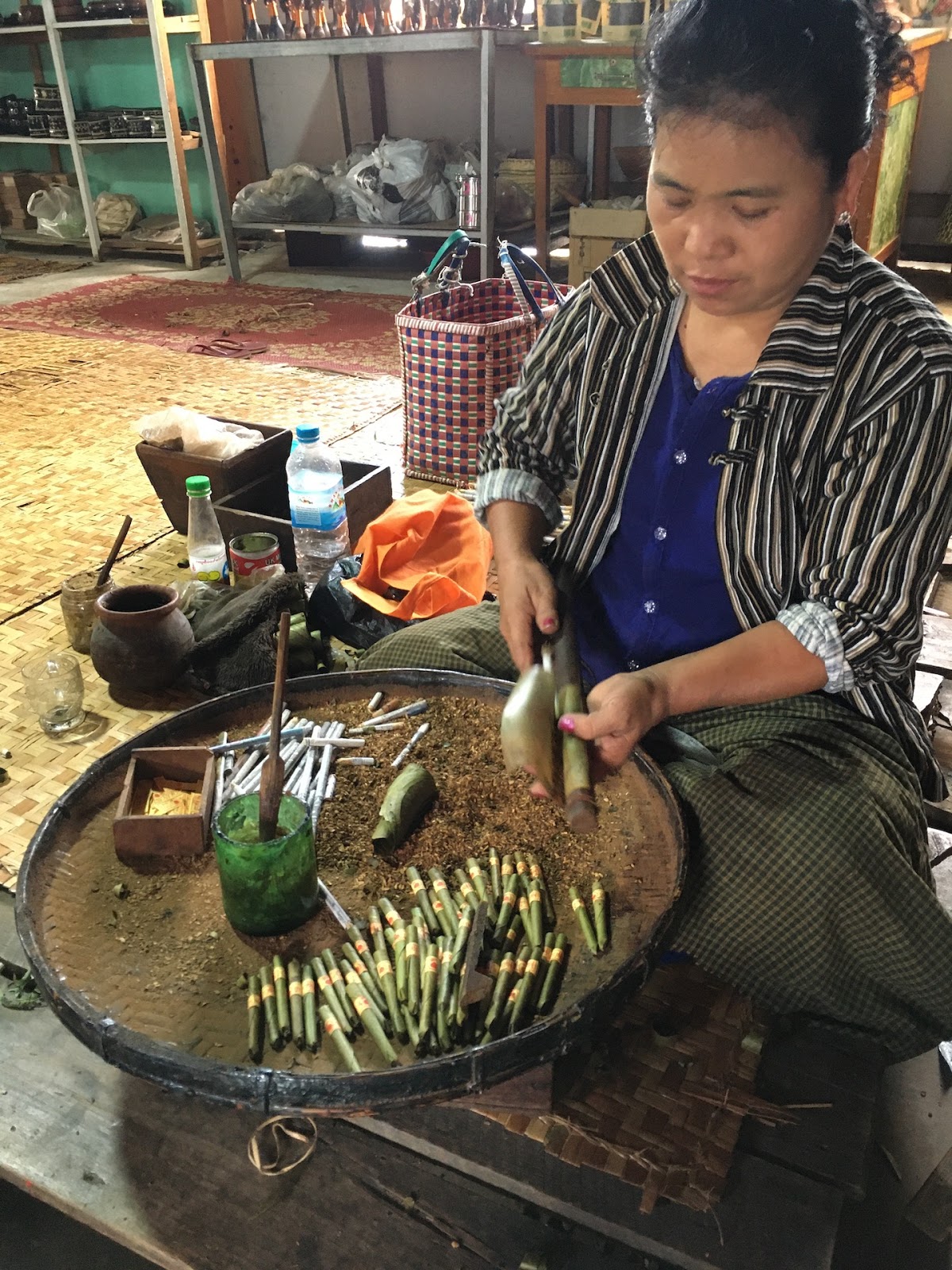
Burmese cheroots are a traditional smoke here in Myanmar. While they have been supplanted somewhat by ready-made cigarettes, there are still a great many local folks that favor these hand-rolled cigars. We departed the cigar factory, but not before I had a small bundle of cheroots tucked into my bag. If nothing else, the smoke they produce is good for chasing off mosquitoes. In truth, the cheroot is not as bad as all that, and my stock of cigars was running low. Besides, the sight of a Farrang smoking a traditional cheroot never fails to bring smiles and comments in the local tea-shop.


Heading Upriver...


Our boatman steered the long-tail away from the lake and up a winding, muddy river. This was pure joy; the roar of the engine against the current, the jungle pressing in on both banks. The boat shot over bamboo weirs as we climbed the current, with the boatman raising the prop just enough to clear the weir. The narrow boar would hesitate against the current as we scraped over the weir, then plunge ahead as our pilot lowered the spinning prop back into the muddy water.

Our lunch stop was along the river, at a shady outdoor café. The young folks that served us were polite, friendly, and spoke English. There were no local folks. Welcome to the Tourist Trail. But the food was good, and the setting was idyllic. We paid more for our lunch than a normal joint, to be sure, but we could see where the money was going. I did not begrudge the extra few dollars spent on our meal.


Many, Many Zedi...


The last stop on the river was the small village of Inthein. From there we set out on foot to tour the complex of the Shwe Inn Thein Paya. More than a thousand Zedi are clustered up a steep hillside surrounded by jungle. Most of the large and small pagodas date from the 17th and 18th centuries. Some are gleaming and bright, others falling to ruin and leaning at crazy angles. It is a strange place, and a wonderful location for a barefoot stroll over the sun-baked stone walkways.


Meditative Felines...


Workshops, markets, temples, Oh My! Back out on the lake, we stopped at the Leaping Cat Monastery. The hulking wooden structures were perched above the lake on thick pilings of teak. None of the cats that I saw were doing much leaping. It was too hot for that. I suppose they were meditating instead.


An Icon on the Water...


The afternoon sun was hot as our boat roared back up the lake towards town. Along the marshy shores we saw the raised beds of tomatoes stretching almost as far as the eye could see. The bushy rows of tomatoes seemed to grow right out of the water. A closer look revealed carefully tended berms of water-logged soil. It was like a giant hydroponic garden.


The Money Shot...


There was yet one more tourist obligation to fulfill. We had to stop for a photo-op with one of the local fishermen. This is the photo that everyone wants, the image emblazoned across the cover of the Lonely Planet guidebook. Here is another irony. The "Fishermen" who work closest to the route of the tour boats are more engaged in being icons than they are in fishing. To be sure, there are fishing boats scattered across the lake, and the majority of those are meant to catch fish and eels from shallow waters. The fishing boats along the water route to town, however, are after a different catch. These folks know that the tourists want that important photograph, and they are happy to play the role for a small fee.

Our boatman slowed alongside one of the fishing boats, allowing us a chance for the image. We slid up next to the smaller craft and the occupant grabbed our gunwales, holding fast with one hand while raising a small fish in the other. I obliged him with the photo you see above, and made my contribution to his fund. Everyone has got to make a living.


Everything Tastes Better on a Stick...


Our boatman deposited us on the shore of the busy main canal. I left him a good tip, furthering my efforts to support the local community. The boatmen themselves get a relatively small cut for their efforts, while a large share of the fare goes to the booking agents. Making sure our guy got a decent cut of the profits seemed like the right thing to do.

The heat of the late afternoon was on us, and it was time to relax. Having played the good tourist, I wanted nothing more than our quiet veranda and a good cigar. Night fell while I saw to both of those needs.

My One and I set out into the sultry night, looking for food that was other than curry. We found a local Myanmar BBQ joint and settled into a meal of grilled food on sticks. It was a busy, family-run joint, open to the night air. Local folks pulled up on their scooters, ordering BBQ to go. The meal was long and slow, an altogether enjoyable evening. When our tables was covered with discarded skewers, and we could not eat another bite, we ventured back to the veranda for another chorus of the night song.

Our tour of Inle Lake was a good day, despite the oddity of being firmly set on the Tourist Trail. So it goes with travel to the Big Sights. One should not expect to be alone amongst the famous places that so many want to see. I was thankful that we have the freedom to travel in the shoulder season. I cannot imagine what Inle Lake is like in the high season of December, when the crowds descend on this quiet place. As it was, the day turned out to be a lovely balance, a mixture of destination travel and small things discovered amongst the large.


Thanks for your interest in my travel blog. I do hope you enjoy it. If you liked what you read here, how about a free short story? My flash fiction piece "Broken Luggage" has recently been featured at the great online journal Five on the Fifth. You can check it out here:


"Broken Luggage" at Five on the Fifth


Or perhaps one of my other novels? All of the information is at my website:

Marco Etheridge Fiction

You can check out books, blog posts, book reviews, or even get a free book. Just look for the big button that says "FREE BOOK." It's kind of hard to miss. Happy reading!!

Sunday, December 1, 2019

Myanmar Chapt. 7 -- Nyaungshwe


All Canals Lead to Inle Lake...


The day came hot and bright, and with it the promise of walkabout in a new town. Nyaungshwe is the largest small town adjoining the ecological preserve of Inle Lake. The lake and the town are located in the Shan Hills, the eastern portion of central Myanmar that make up the Shan State. The lake sits in a wide, flat valley, surrounded on all sides by green-clad mountains.

People often ask me what I do on my travels. My answer is that I walk around and look at things. Sometimes I find big things, other times I find small things. Each country or city has its important monuments: The Statue of Liberty in New York, Angkor Wat at Siam Reap, or Luang Prabang on the shores of the Mighty Mekong.  A traveler may see any one of these, and yet not know a thing about the land and people of a place. Walkabout allows one to experience day-to-day life; the small sights, smells, and tastes that make up the fabric of a country and its culture.

Here I risk the danger of letting my snobbish nature show, but I will plunge on nonetheless. I have listened to well-heeled travelers tell me of having been to Cambodia of Laos. They fly into Siam Reap, tour Angkor Wat, then fly away. Or they spend a few day in the UNESCO World Heritage Site of Luang Prabang, claiming that they have seen Laos. I do not deny the wonder of both of these amazing treasures. Yet I also know that there is so much more which defines a new land. One of the best ways to experience these small things is to set out on foot with no clear destination in mind. The Travel Gods rarely fail to reward such effort, even if the reward comes in surprising and mundane ways.


The Walkabout Calls...


Our breakfast, including real coffee, was served by our smiling host. The breakfast room was on the second floor of the lodge, with views all around. The land spread out before us, flat and green in the morning sun. I could see small lanes leading out into the flat, green countryside; paths that led towards the marshy lake. Clouds floated over the tops of the mountains, while a hot sun beat down on the rice paddies. It was more than a traveler could ask for, more than I could resist, and we were not long in setting out.

We crossed over the canal in front of our guesthouse compound and headed away from the edge of town. The gravel way led due south, following the path of the sluggish canal. There was water everywhere, on either side of the path, in the canal, or glistening below the emerald green of the fields of rice. We had no fixed destination, no demand on our time, and nowhere to be.

Lying in the road, My One found the carcass of the biggest grasshopper I have ever seen. The thing was a full four inches long, more than an inch thick, and iridescent green. Small fish broke the surface of the canal, hunting insects that were not so gargantuan. All manner of birds flitted through the branches of the scrub bushes on the side of the path. It was glorious walking on a sultry morning.


A Village Temple...


We came to a meeting of ways and chose the one that looked the most traveled. There was a line of buildings in the distance, including the golden gleam of a few small pagodas. The rice paddies were on our right hand, and the beginnings of the lake marsh on our left. The raised pathway led past teak houses on stilts. Farm folk were going about their chores. We greeted them with smiles and our best Ming-ga-la-Bah, which is always answered with a beaming Burmese smile.

At the far end of the lane, defining the very large square we seemed to be circumnavigating, we bumbled into a farmer's compound. He steered us away, but gently and with a smile. Finding a path that led north along the main canal, we strolled past a small, brightly painted temple. Lotus blossoms grew in the ditch alongside the path, anchored by long roots to the mud beneath. There is a Buddhist saying: No mud, no lotus.

We were heading back towards the town now, and our pathway became a proper road. We could hear the unmuffled roar of long-tail boats plying the canal, caught glimpses of them between the buildings. The buildings seemed to be mostly warehouse structures. There were piles and piles of wooden crates stacked up in front of each of these buildings. We soon learned what the crates were for.

There were mounds of tomatoes, mountains of tomatoes, long tables of tomatoes. Workers stood at the tables, sorting tomatoes into crates. The combination of rich, flat bottom land, ample water, and fierce sun make this lake valley a prime tomato producing region. The tomatoes all seem to be of the Roma variety; smallish, oblong, and bright red.


The Local Tea-Shop...


We wandered closer to town, close enough to attract the attention of the Boat Shills. Inle Lake is the big attraction here, and no visit is complete without chartering a long-tail boat to tour the lake itself. It is not yet the high-season, so there are not enough tourists to go around. Hence the Boat Shills. These guys run around on scooters, looking for tourists to pitch. We received a fair few of their pitches, which we politely declined. Today was for walking. We had set aside the morrow for a boat excursion.

The road became busier. There were tractors hauling loads of tomatoes, taxis hoping for a fare, and the ubiquitous stream of scooters. Where the main canal crossed under the main road, we saw the idle fleet of long-tail boats moored at many rickety docks. Turning right again, we began strolling into the town proper, the last leg of a very large box.

The afternoon was bringing the clouds down from the surrounding mountains, and with it the threat of rain. By early November, the rainy season is ending, but it is not completely spent. It was time for cup of chai, preferably at a joint that had a roof.


Main Street Under Clouds...


We spent a good bit of the afternoon hanging out in the tea-shop and watching the world go by. The busy little main street gave us all the entertainment we needed. When the threat of rain eased, we headed back to the guesthouse for a late-afternoon smoke and some well-earned relaxation on the veranda of our cute little bungalow. 


Curry With Most of the Fixings...


The night fell hard and black in a town where streetlights are few and far between. Armed with our trusty LED torch, we headed out to find some dinner. We were not disappointed. A typical Myanmar curry revolves around the rice. Accompanying the rice are a small dish of curry and a variety of savory side dishes. There are pickled things, spicy things, vegetable things, and dishes I cannot readily identify. Some are wonderful, some are strange, and the side dishes seem to change each day and at each curry joint. The assortment you see in the photo above was only a part of the meal. Before I could tuck in, more dishes arrived.


And with All of the Fixings...


I had to rise from the table in order to capture everything in one photo. Besides the dishes mentioned above, there was a lovely soup and a big plate of green vege. This extravagant feast will usually cost about 3,000 kyat, or two dollars US.

Our meal complete, we wandered back to our bungalow. Once more enjoying our perfect veranda, we were serenaded by the chorus of night critters. Tree frogs tried to out-sing the crickets, while the Hoo-How birds cried out from the dark trees above us. Two giggling girls made their nightly rounds, offering to spray our veranda with the biggest can of bug repellent I have ever seen. We declined, preferring to shoo the mosquitoes rather than suffer the effects of a toxic cloud.

It had been a quiet day, a small day, a day blessed by a remarkable walkabout. There was nothing wondrous to report, unless it was the small wonder of discovering small things. Tomorrow we would do the big things: A boat tour of Inle Lake. For tonight, we were content to sit and talk and laugh. the big things could get along without us.


Thanks for your interest in my travel blog. I do hope you enjoy it. If you liked what you read here, how about a free short story? My short fiction piece "The Last Lost Eye" has recently been featured at the great online journal Literally Stories. You can check it out here:


Or perhaps one of my other novels? All of the information is at my website:

Marco Etheridge Fiction

You can check out books, blog posts, book reviews, or even get a free book. Just look for the big button that says "FREE BOOK." It's kind of hard to miss. Happy reading!!