Wednesday, November 27, 2019

Myanmar Chapt. 4: Riding that Train


The aging Yangon station...


Before we begin, I am obliged to come clean with a Fan-Boy disclaimer: I love trains. More than that, I love old, slow trains. The clickity-clack rhythm of an ancient rail coach being pulled by a decades old diesel locomotive? That's the ticket, Jake! The open-windowed wagons wallow along over absurd narrow-gauge track dating from colonial times. We are talking train cars that rock from side-to-side like a woman of questionable morals in a David Bromberg song. Yes Sir, I admit it: I love me some old trains. Sri Lanka, India, Thailand; bring them on. Now we could add Myanmar to the list.

The smiling man behind the barred window pushed his hands out, fingers splayed wide: "Upper Class all booked. All Booked!" We would be riding Ordinary Class from Yangon to Bago. The queue for tickets is a scrum, a polite but firm pushing match. The object is to maintain position and at the same time block out the steady, fleshy pressure of a longhi-clad Auntie forcing her way past like a slow and slippery eel. A young-old guy with the purple-stained teeth of a Betel-chewer leans against the railing, asks us the ubiquitous question:

"Where you go?"

"Bago," say we, trying to nicely ignore the guy. I'm concentrating on the scrum. My one is guarding the bags outside the steel railings that hold in the queue.

"Two people, two passports please."

Now there are three prime forces in play, all pressing in on me. There is the force of the scrum, and Auntie Eel trying to slip under my elbow. There is the force of the prime directive: Never Give Up the Passport! And there is the force of me wanting to know what the scam is.

My Heart shrugs at me, standing outside the press, and we hand this purple-smiling guy our passports. He immediately launches himself over the scrum, looking like a body-surfer in a mosh pit. His hand swoops through the bars of the ticket counter, landing our passports in front of the ticket guy. Our guy flashes us the crimson teeth and disappears into the crowd; there was no scam. I look up to see a dusty sign overhead: "Be helpful and courteous to Foreign Tourists."


The Beginnings of the Magenta Smile...


Crimson teeth? Purple smile? I can hear you asking: "What the hell are you talking about, Marco?" Yes, it is time for the Betel Nut Aside:

You know that Yangon is a Buddhist town, a peaceful town, yet there are splashes of crimson at nearly every curb, every lamp-post. The red splatters that you see are not blood, but rather the expectorate of betel chewers. There are Kun-Ya stands on almost every block in Yangon. These tiny kiosks supply the chewing needs of the people, and many, many people have the need. Paan, or Kun-Ya, is a quid made from areca nut, betel leaves, dried tobacco leaves, and slaked lime paste. The quid  sellers spread the lime paste (calcium hydroxide) on the betel leaf and sprinkle the tobacco and powdered areca nut on top before neatly folding the leaf into a small, square packet ready for chewing. A fix of betel chew costs the equivalent of $0.13 for four to six servings.

Betel quid acts as a mild stimulant, while staining the chewers teeth a violent magenta. Articles I have read suggest that 50-60% of Myanmar men chew Kun-Ya, and 40% of the women as well. It takes practice to avoid staring when a betel chewer flashes you the purple smile.


Another Scrum...


Meanwhile, back at the station, the ticket man examined our passports, hand-wrote and stamped our tickets, gave the back of the tickets a few stamps for good measure, then handed the things over. The fare from Yangon to Bago was about $0.80 per person. Here in Vienna, eighty cents won't get you on anything, even if you are a senior citizen with two canes. In Myanmar, that same worthless eighty cents is going to entertain you for a good, long time.

It is about ninety-one kilometers, or fifty-seven miles, between the Yangon station and Bago. The train time between the two is two-and-a-half-hours. I'll even do the math for you. That means our speedy train is hurtling along at an average speed of 36.4 kilometers per hour, or 22.8 mph. Yes Sir, our train is a slow train, a train worthy of Flanders and Swann, or Bobbie Dylan.


Rolling Stock from Another Era...


My One on the Green Train...


The conductor led us to our Ordinary Class coach, making sure we had the correct seats. The plastic seats are hard and slippery, replacements for the older wood-slat benches. The gimbal-mounted overhead fan is exactly the same model as trains in India, Sri Lanka, etc. It is a brilliant old piece of engineering, a heavy thing that oscillates and maintains a tilted angle at the same time.

The train car begins to fill with locals. Folks settle in, stashing their bundles and bags. Finally, not far off the scheduled departure time, the train whistle echoes down the platform. The cars lurch, squealing in protest, and we chug out of the station.


Train Buddy...


Traveling out of a city by train is to see the unvarnished, the sights and smells that are hidden from the road. It is not necessarily the prettiest view of a city, but it is often the most real. This has been my experience across the globe, whether coming into the South Side of Chicago, or the teeming shanty-towns on the outskirts of Bangkok.

Along the periphery of Yangon, the less-than-lovely pass by: piles of plastic trash, ditches of fetid water, clusters of shacks that are home to entire families. These are the visions not captured on the travel sites, not hawked as picture postcards.


The World Passing Slowly...


Once out of the city, our train lumbers across impossibly green fields. The wet season is sputtering to and end, leaving the entire land soggy and fecund. Ponds and irrigation canals are full to the brim, the surface of the water backed up to within a few feet of rickety houses on teak stilts. The water table lies just below the surface. A few strokes with a shovel will strike water.


Time Moving Slowly...

I love these slow train rides because the train becomes the journey. The destination is not the point. Nor is it wise to concentrate on the end point. The trip may take a lot longer than one thinks. We are only going to Bago, but our speedy little train will go all the way to Mandalay, fifteen to eighteen hours up the track, depending on the whims of the Travel Gods.

We stop in small stations, where passengers and sacks of freight are loaded onto the train. Vendors pile on as well, or walk past the open windows. They are selling fruit, sweets, quids of Kun-Ya, anything you can imagine and many things that you cannot. Sometimes we stop in the middle of nowhere, for no apparent reason. Through the open windows, I see rice paddies stretching away as far as the eye can see. Snowy white egrets are reflected in the still waters. Then the train whistle blows, the wagons lurch and groan, and we lumber off.


Finally, as the shadows are growing long, our train crawls into Bago. As with every other place in Myanmar, there are many names for this town. It is also called Pegu, for the Pegu river that flows through it. It was once part of the Pagan and Hanthawaddy Kingdoms, dating back to somewhere in the sixth to eleventh century CE. It is a famous site for Buddhist pilgrims, with pagodas and Buddhas scattered across the river plain.

We dodged off the first two shills that pounced us outside the train station. There was the usual strange smattering of stilted, formal English.

"I am a guide, Sir. Will you not take advantage of my knowledge. We have taxis here. Have you booked a room?"

Shouldering our packs, we left the shills behind. A block further on, we found two moto-taxis and negotiated the fare to our guesthouse. There was some discussion as to where it might be, some puzzling over the screen shot of a map, then we were off into the evening traffic. You are a big Farang with a backpack, perched on the back of a tiny scooter. Hang on, keep your knees in, and hope for the best. 

Riding out into the river flats, I figured the scooter guys would either take us to a dark rice paddy and murder us, or eventually find the guesthouse. It was full dark by the time we arrived at our guesthouse. I tipped our guys for not choosing option number one, and sent them on their way happy. The Travel Gods had smiled on us. Another day of journey was safely done.


Sources on Betel Quid: 
Myanmar Health
by Mratt Kyaw Thu, Yangon, Myanmar


Thanks for your interest in my travel blog. I do hope you enjoy it. If you liked what you read here, how about a free short story? My short fiction piece "The Dangerous Egg" has recently been featured at the Manzano Mountain Journal. You can check it out here:

"The Dangerous Egg" at Manzano Mountain Review

Or perhaps one of my other novels? All of the information is at my website:

Marco Etheridge Fiction

You can check out books, blog posts, book reviews, or even get a free book. Just look for the big button that says "FREE BOOK." It's kind of hard to miss. Happy reading!!


Tuesday, November 26, 2019

Myanmar Chapt. 3: Building Pagodas, Making Merit

Myanmar Brekkie...


Before setting out on a walkabout, it is always wise to lay in a solid breakfast. Today's choice was roasted and salted chickpeas with flat-bread and mohinga, a fish curry noodle dish that is the standard Burmese brekkie.

Myanmar is a land renowned for its pagodas. Burmese pagodas, like European cathedrals, or Thailand's many wats (temples), are a mixed blessing. We have a saying, a result of many trips to Thailand: "Here a Wat, there a Wat, everywhere a Wat-Wat." I do not mean to be sacrilegious. There is, however, a point at which the awe-inspiring fails to inspire awe. It is what I call the Angkor Wat syndrome. The traveler can only take in so many glorious monuments to this or that deity before it all starts to wear a little thin.

And yet, Myanmar is the Land of Pagodas, reputed to have more Buddhist Phaya, Zedi, and Phato than any other country. There is usually at least one gold spire or dome in sight at any given time. Why so many pagodas? A good person (or a bad person hedging his or her bets) can donate money to build a pagoda. This is a solid way to make merit. People erect a pagoda in this life with the hope of reaping rewards in the next life. The Lord Buddha did not teach any sutras regarding the building of pagodas. Dogma being what it is, redemption through pagoda building became an add-on, much like Papal Indulgence in the Catholic Church.

Our goal for the day was Shwedagon Pagoda, the crown jewel of any Yangon tourist worth their salt. It was a long walk, so we opted to shorten it by using the public bus system for a portion of the distance. Mastering the mysteries of a city's public transit system is a joy in itself, particularly when one is in a land that makes use of non-Latin script. Poor Traveler, you cannot read the signs (or numbers!) on the buses. Let the games begin!


Tiny monks...


Before we could set out on our adventure, there were necessities to attend to, specifically coffee and a morning smoke. While enjoying both, we were witness to a much more common method of making merit. The local monks were making their rounds, collecting food alms for the day. Preparing food for the monks is a common practice here, as it is in Thailand and Laos. It is a daily routine which keeps the monks fed, and allows the lay people to acquire merit for their good deeds.

As a nation, Myanmar has the highest percentage of Buddhist monks based on population, and the highest percentage of income spent on religion. A large percentage of boys and young men become novice monks for a period of time. Buddhist monks have been a significant force in the politics of Burma, and later Myanmar. The influence of the monastic orders remains a powerful force in Myanmar politics, with sometimes questionable results.


Yes, these are the main train tracks...


We are off into the heat of Yangon, the sun pressing down on us. A ride on the public bus costs 200 kyat, or about twelve US cents. For that modest price, the rider is treated to a respite from walking, and an up close and personal experience of humanity. This would be the time to abandon any notions one has of personal space. Packed cheek-by-jowl, the good commuters take it all in stride as the bus defies the laws of physics. More people are crammed into a defined space than there is space, but somehow it is accomplished. The riders remain stoically cheerful, squeezed all together like longhi-wearing sardines.


Pagodas and clouds...


Gawking our way through small, twisting streets, we made our way north of the huge public market. Even the pedestrian bridge over the train tracks was used as a market space. Beyond the market were shadier lanes, then dead-ends that spit us out onto one of the huge sun-baked boulevards. Feeling the need for refreshment and shade, we veered off into the pathways of the lesser pagodas and mausoleums that line the approaches to Shwedagon Pagoda.

We wandered about the vast complex of monasteries, temples, and tombs. Scattered amongst the gleaming gold spires were the ancillary businesses catering to the religious pilgrims. There were cafés, of course, of which we took full advantage. But there were also astrologers, fortune tellers, and shops selling all manner of Buddhist icons. 


Lunch for the foot-sore pilgrims...


One would not think it possible to lose a 368 foot high golden pagoda, but lose it I did. We twisted through a narrow maze of a neighborhood, a wonderful distraction in itself. Finally, catching a glimpse of our goal, I managed to right our course and we found one of the four main entrances.

Barefoot now, we climbed the long, covered stairs that lead to the heights above. Like any good temple stairway, this one was lined with stalls selling all manner of religious souvenirs. it is a common gauntlet, on that repeat itself in religious sites the world over.


A maze of pagodas...


Shwedagon Pagoda is a Zedi, a bell-shaped dome containing sacred relics of the Lord Buddha. In this case, the relics were a few hairs of the Buddha, given to two Burmese merchant brothers who had traveled to India. The sacred hairs were returned to this ancient Burmese city, where they were enshrined in the original Zedi. Destroyed many times by war, earthquakes, and fire, the pagoda has been rebuilt following each disaster. With each rebuilding, it has grown taller and more magnificent.


Shwedagon Pagoda


The main spire is surrounded by many other pagodas, temples, and monastic buildings. Arriving at the main platform of the place, we found out where the other tourists had been hiding. we certainly had not seen them on the streets of Yangon.

There were many, many people here. Myanmar folks were busy making merit, laying lotus blossoms and lighting incense sticks. There were monks everywhere, their saffron robes a vivid contrast to the immense fields of gold paint and gold leaf. Outnumbered by the local folks, small knots of foreign tourists made their way around the pagoda, cameras at the ready.

Despite my jaded comments about temple burn-out, Shwedagon Pagoda is indeed magnificent. It was made more so by the dark afternoon thunderclouds that threatened, but did not strike. The golden spire seemed to pierce through the heavy, sultry clouds, shining ever the brighter. We lingered long, circling the pagoda barefoot to make merit for the day.


The gloaming of the day above the spire...


The gloaming of the day was upon us, and our feet weary. It was time to think of things more temporal and leave the sacred behind. We wandered off into the darkened streets, seeking out food and rest.


The gateway at nightfall...


Neon Temple...


Even amongst the city streets of Yangon, there are constant reminders of the religious nature of this country. A neon-bright Hindu temple lit up the street, adjacent to a Buddhist monastery and a very incongruous Salvation Army building. All this in one city block.

After a wonderful Thali platter in a busy Indian joint, our weary feet drew us home to our guesthouse. Along the way, we passed a busy mosque where the faithful were heeding the call to prayer. We had been good tourists today, "Pleasuring with a vengeance" as Mark Twain would say. The rest of the evening was spent at the outdoor bar in front of the guesthouse, sipping tepid drinks, smoking, and watching the street theater. Tomorrow we would set out for Bago, riding the narrow-gauge trains of the Myanmar railway.


Thanks for your interest in my travel blog. I do hope you enjoy it. If you liked what you read here, how about a free short story? My short fiction piece "The Broken Vow of Ramón Torres" has recently been featured at Inlandia Journal. You can check it out here:

"The Broken Vow of Ramón Torres" at Inlandia

Or perhaps one of my other novels? All of the information is at my website:

Marco Etheridge Fiction

You can check out books, blog posts, book reviews, or even get a free book. Just look for the big button that says "FREE BOOK." It's kind of hard to miss. Happy reading!!


Friday, November 22, 2019

Myanmar Chapt. 2: Yangon

Sule Pagoda Circle, Yangon's Center Point

What can I tell you of Yangon, the former colonial capital known as Rangoon? First, there is the obvious: Yangon is hotter than a wet monkey in a Turkish bath. It is a welcome reminder, an embrace as sticky as an old Midwest Auntie in August. But I am out in it, running sweat, feeling the noise, the heat, the smell of a new Southeast Asian city. Life is good.

The neighbors across our street are already in full swing. The tri-shaw repair shop is open. Banging hammers and snarling grinders are the soundtrack for the impossibly overloaded tri-shaws pedaling past. They are called "saiq-Ka," a transliteration of side-car; old Mao bikes with a flimsy two-seat sidecar welded to the questionable bike frame. I saw one of these contraptions loaded down with 200 kilos of rice, the pilot standing on the pedals to force the thing down the baking roadway. Anything can be transported by tri-shaw: thirty-foot bamboo poles, steel pipe, families; anything.

In front of the tri-shaw shop, life is going on. Hair is tended to, babies are washed, games are played. City buses lumber by only a few meters away and no one dies. I am mesmerized by the scene, but the city is calling and it is time to go walkabout.


Yangon versus Nature


Yes, what can I tell you of Yangon? `It is not Bangkok, nor is it Colombo. Yangon feels like a synthesis of SE Asia and the subcontinent, yet separate from both. It is a city under siege, not from armies of the past, but rather from time and the elements. Water and humidity eat into concrete, into brick. Concrete sprouts bands of black mold. Cornices crack under assault from the probing roots of clinging vines. The water seeps in, slowly, cracking façades, nibbling away stucco. Tiny ants attack any wood that is not teak. The wood is bored, eaten, digested; miniature pyramids of fine dust are left behind. Trees grow inside buildings with no roofs. The tree roots topple walls. There is a dream-like surrealism at work here, a feeling of being inside a Gabriel García Márquez novel.


Colonial Spiral...


When this city was known as Rangoon, it was the main port for the British colony of Burma, part of the larger Raj of India. Burma was considered a hardship post, the furthest-flung corner of the Raj. The legacy of the colonial era can be seen throughout the center of the city. Colonial buildings, many of them in danger of tumbling down, are cheek-by-jowl with more modern concrete shophouses. The British laid out the main avenues east-to-west along the confluence of the Thwante and Pegu rivers. The goods extracted by the colonialists were shipped down the river to the Andaman Sea. Yangon fell to the Japanese in WW2 and was not recaptured until late in the war. The British tried to reinstate their colonial control, but Burma became an independent country as the British Raj fell apart.

We walk and we sweat, exploring the narrow north-south streets that form the grid between the few larger boulevards. Along the riverfront, warehouses block the view. Colonial edifices line the Strand: the Strand Hotel, the Post Office, the Police Courts. A night at the Strand Hotel will set you back about 400 Euro, in case you were feeling posh. Our modest guesthouse is about $30 per night, just for reference.


Myanmar Curry


After a first round of walkabout, it is time for a shady street and food. The centerpieces of Myanmar cuisine are rice and curry. The curry here is not as fiery as Thai curries, nor as creamy as Indian curries. The Myanmar curries are cooked "until the oil comes," a separation of the oil used to make the curry paste. The curry and rice are accompanied by soup, a platter of fresh vege and greens, and an ever-changing variety of condiments served as small side dishes. A full meal of curry with all the fixings will set a hungry traveler back about 3000 Kyat, or a bit less than two dollars.


Turtles, Sky, Clouds


There is shade in the colonial park, near the bustling traffic circle that girds the Sule Pagoda. People sprawl in whatever shade there is. There are birds, turtles, and the occasional rat wandering along. Yangon rats do not run. I believe that they know that the majority of folks here are Buddhists. The Indian folks are mostly Hindu. I guess the rats figure their odds are pretty good; there is no need to scurry.


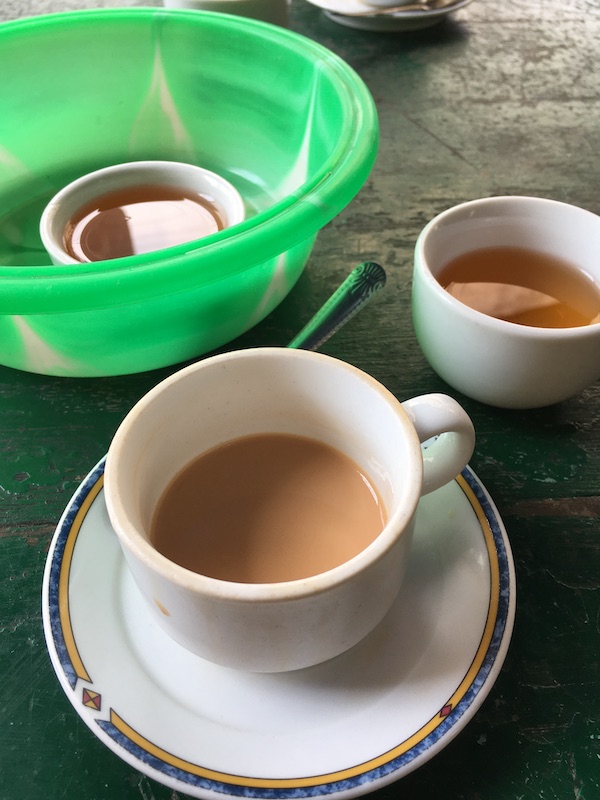
The ubiquitous chai, the milk tea of India, is a staple at the many tea-shops. The sweet, thick tea is served alongside all of the oolong tea one can drink. Hot afternoons are spent in the open-air tea shops, squatting on rickety plastic stools, smoking and talking. Coffee drinkers are at a disadvantage here. Aside from a few trendy coffee houses, most of what is on offer is vile instant.

Men crowd around the low tables, watching the afternoon go by. They pull up their longhi, or longyi, wrapping it around their knees. A longhi is a type of sarong, an ankle length tube of cotton that is gathered and tucked at the wearer's waist. The majority of men wear the longhi. This makes for an interesting societal observation: Myanmar is a society without pockets. Thus, cellphones, wallets, etc, are tucked into the upper fold of the longhi, exposed and in plain view to all. This city would be a pickpockets paradise except there do not seem to be any pickpockets. It may be one of the safest cities in the world, at least from petty theft.


Bogyoke Aung San Market


We thread our way through the city, past the colonial center and into the teeming Indian and Islamic quarter. The narrow streets are packed with three- and four-storey shop-houses, their goods spilling out onto the sidewalk. Sidewalks are not for walking; they are an extension of whatever business they front, be it a shop of a café. One walks in the street, making room for tiny delivery vans, tri-shaws, and scooters.

Our furthest stop of the day was the teeming warren of the Bogyoke Aung San market. Every Asian city worth its salt has at least one huge covered market. In Yangon, this is it. Flip-flops by the bale, cheap jewelry in gleaming displays, side aisles so narrow you have to turn sideways to allow a fellow shopper to pass. It is shaded from the sun, yet the heat is amplified by the metal roof high overhead. It is a bit like shopping in a giant toaster oven.


Train tracks pressed by city and jungle...


Done in from our first Yangon walkabout, we turn our steps back to the guesthouse. Not far from our digs, we have to cross what looks like an abandoned train line. As I was to learn late in the night, these tracks are not abandoned, despite all the evidence to the contrary. The tracks lead to a locomotive yard on the far side of our street. I was awakened from a dream by the moaning horn of a locomotive picking its slow route along these very tracks. I cannot explain the how of it, only that it happened.


Halal Chinese, a new delight...


After a long rest, we ventured out for our evening meal. Both of the places I had researched were closed, but we were rewarded for rolling with adversity. We found a small joint on a narrow side street, a Halal Chinese place. I did not know that such a combination existed, yet here we were. The food was so good we went a little crazy, spending the princely sum of ten dollars for dinner for two. Everything was exquisite, from the prawn salad to the fish stew.


Back at the guesthouse, it was time to enjoy the gloaming of the day. We sat in the street-side outdoor bar, watching the local folks party it up. The drinks were tepid, the night was sultry, and my cigar was well-earned. Our first full day in Yangon had been a great introduction to Myanmar.


Thanks for your interest in my travel blog. I do hope you enjoy it. If you liked what you read here, how about a free short story? My short fiction piece "Ghost Hats" has been featured at Literally Stories" You can check it out here:

"Ghost Hats" by Marco Etheridge -- Literally Stories 

Or perhaps one of my other novels? All of the information is at my website:

Marco Etheridge Fiction

You can check out books, blog posts, book reviews, or even get a free book. Just look for the big button that says "FREE BOOK." It's kind of hard to miss. Happy reading!!


Wednesday, November 20, 2019

Myanmar Chapter 1: Paying the Piper


And away we go...


When the chill of Northern Europe is in the air, and Vienna's stony streets are cold and dark, thoughts turn to Southeast Asia. I hear the siren call of sweaty, humid days, and warm sultry nights. Where have we not been? Where could we, should we, go? We spin the Asian Destination Wheel (ADW) and, voilà, this time it is Myanmar.  

Formerly known as Burma, and as a down-trodden English colony, post-WWII Myanmar languished under a series of juntas and military rulers. Following two and a half decades of civil unrest, political intrigues, and the protests of Buddhist monks, the Myanmar government in 2015 held open elections. As a result of these elections, the National League for Democracy won an absolute majority. The military remains a powerful force in Myanmar politics, yet the country is moving towards a modern democracy, albeit in fits and starts. This is in contrast to Myanmar's neighbor, Thailand, which is slipping back into a military junta.

There will be much more to say about Myanmar's politics and history, but for now we need to be leaving cold, gray Europe for hot, humid SE Asia.


The little plane to Yangon...

Roaming the globe means paying the piper. Thus it has always been, and shall always be, unless we suddenly invent teleportation. "Beam me to Myanmar, Scotty!" Alas, we are still getting there the old-fashioned way, with hours of time spent in the aluminum tube. Two hour early to the airport for an international flight, ten hours to Bangkok, two hours in Bangkok, then a short hop to Yangon (Rangoon). About sixteen hours of planes and airports. Pay up, Traveler.

My secret to air-travel is to get stupid. I try to dial that brain activity down to about a three. I watch lots of movies, particularly Pixar movies. Sure, I've seen them all, but cute, animated movies are a great way to sooth that impatient brain. Thinking about time is a killer. I'd rather watch Woody and Buzz do silly stuff. Always have a book, an e-reader, something. Eat the airline food slowly. Play games with the little plastic food trays. The time will pass if you don't engage with it. 

The time does pass, and then we are wandering though the vastness of Bangkok's Suvarnabhumi airport. This is familiar ground, and the pull of my favorite neighborhoods in the Big Mango is strong. But there will be no stopping over on this trip. We thread through the maze, through the next security check, and eventually onto the little plane. I hear the whisper; almost there.

Yangon, formerly Rangoon

The plane drops in over a painfully green landscape. The rainy season in just ending. Below us, shimmering water threads in every direction. Electric emerald fields roll out across the flat bottom land. Then there is Yangon sprouting up along wide, shining bands of rivers. 

The legalities of entry go off without a hitch. Our visas are accepted and our passports are stamped by the unsmiling immigration folks. Both backpacks slide down the baggage carousel; always a welcome sight.

Then there is a smiling young man holding up a sign with my name on it. We will free-lance the rest of the trip. booking guesthouses as we go, but it is always a good idea to have that first place locked down. Searching for a place to stay after a long flight is a fool's errand.

Stepping out of the airport is to step into a wash of heat and humidity, that familiar first sultry, sweaty embrace of Asia. You are back; welcome home. Our driver pilots us through the cramped streets of a new Asian city, yet the scenes are familiar. There is the tangle of traffic, the open shop fronts, life being lived out of doors. He asks us the direct, yet polite questions typical in this region. How old are we, how many children do we have. I let My One answer him while I take in the passing cityscape.

We have arrived in the morning, the worst of hours for Mr. Jet-lag. The best possible option is to stay awake, push through until bedtime at the local hour. After twenty hours of no sleep, this is simply not an option. We opt for a three-hour nap, cast ourselves down on the bed, and slip into oblivion.

Shan Noodles


With rest and a shower, there is the need for real food. We set out on foot, exploring our new neighborhood in our new city. The method is always the same: find a joint that is packed with local folk and settle in. Wandering down narrow streets, past food stalls and vendors, we are the only Farang. Folks look at us with serious faces. We try out our first words of Burmese: MING-ga-la-BAH. The reward is bright smiles all around, a nodding of heads, greetings in return. So it passes as we search for our place.

When we find it, we know it is the noodle joint we were looking for. There are bright fluorescent lights, lot of people, and the atmosphere of a crowded bus station waiting room. The kid waiters are friendly, amused by the Farang in their midst. The noodles are wonderful; hot, full of fish-balls, the perfect antidote to airline food. Sated, we make our way back to the guest house as the tropical night falls.

Life lived in the open...


A ubiquitous fact of life in Southeast Asia is that it takes place in full view. Work is done in shop-houses that are open to the street, and to the world. When the time for work is done, families relax in front of the same shop-houses. Meals, drinking, arguments, games, haircuts; they all unfold in the open. It is free theater. All one needs is a rickety plastic chair, a cool drink, and perhaps a good cigar. We whiled away the rest of the evening watching folks do what folks do. 

The night was warm and humid, the neighbors loud and boisterous. There was no need for anything else, until the lack of sleep crept over us. We climbed the stairs to the top of the guest house, threw ourselves down on the bed, and slipped into the sleep of our first night in Myanmar.


Thanks for your interest in my travel blog. I do hope you enjoy it. If you liked what you read here, how about a free short story? My short fiction piece "Ghost Hats" has been featured at Literally Stories" You can check it out here:

"Ghost Hats" by Marco Etheridge -- Literally Stories 

Or perhaps one of my other novels? All of the information is at my website:

Marco Etheridge Fiction

You can check out books, blog posts, book reviews, or even get a free book. Just look for the big button that says "FREE BOOK." It's kind of hard to miss. Happy reading!!


Saturday, September 14, 2019

"Breaking the Bundles" is now LIVE!


It has been a long road to get here, a road full of detours and setbacks, but my new novel, "Breaking the Bundles," is finally a published reality. This exciting absurdist thriller is available at fine online booksellers world-wide. I do hope you will check it out.

Kindle Readers can click here:

"Breaking the Bundles" at Amazon Kindle

For the Kobo, Nook, Apple Books, and other readers, click this handy Universal Book Link:

"Breaking the Bundles" Universal Book Link

And if you would like to know a bit more about the novel, here is the teaser...

Vienna, Austria, a city of palaces, music, and cafés. But behind the cold, grey stone lies a dark secret. Against this backdrop of culture and shadows, the fates of three unforgettable peopl;e will be drawn into a common peril.

As the lives of the characters cross, revenge shifts to passion, betrayal becomes an act of honor, and the past exacts a heavy toll from the present. The secrets of the past threaten the lives of those who hold them; the same secrets threaten the men who work in the shadows. The weight of the past will pursue Perry Farmon and Zita de Luca across continents, threatening their love and their lives. The chase becomes a conflict of revenge and desire, of shadow and light, of love and the struggle to survive.


Thanks for being Readers! Readers ROCK!!


Thanks for your interest in my novel. I do hope you enjoy it. If you liked what you read here, how about a free short story? My short fiction piece "Ghost Hats" has been featured at Literally Stories" You can check it out here:

"Ghost Hats" by Marco Etheridge -- Literally Stories 

Or perhaps one of my other novels? All of the information is at my website:

Marco Etheridge Fiction

You can check out books, blog posts, book reviews, or even get a free book. Just look for the big button that says "FREE BOOK." It's kind of hard to miss. Happy reading!!


Thursday, August 8, 2019

New Story: "The Last Lost Eye" at Literally Stories.


I am very pleased to announce that another of my short stories has been picked up for publication and is now live. "The Last Lost Eye" is available for your reading pleasure on the great site Literally Stories. "The Last Lost Eye" is the tale of Odysseus and the Cyclops from the Cyclops’ injured point of view. If you like what your read, please tell someone about the story. And, a HUGE shoutout to Literally Stories for publishing my work.

 Just click the link below for a free read!


"The Last Lost Eye" by Marco Etheridge -- Literally Stories

And... cue the announcement music: My short story "The Rosary" was recently short-listed for the Anton Chekhov Very Short Fiction Prize. While the story did not win, it was listed among the top twelve stories out of almost five hundred entries. 

Look for updates on this and other upcoming stories.

Ciao for now, and thank you so much for being readers!!


Thanks for your interest in my short fiction. I hope you enjoyed the story. If you liked what you read here, how about another free short story? My short fiction piece "Ghost Hats" has been featured at Literally Stories" You can check it out here:

"Ghost Hats" by Marco Etheridge -- Literally Stories 

Or perhaps one of my novels? All of the information is at my website:

Marco Etheridge Fiction

You can check out books, blog posts, book reviews, or even get a free book. Just look for the big button that says "FREE BOOK." It's kind of hard to miss. Happy reading!!